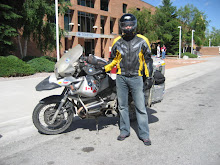
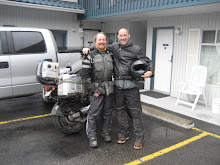
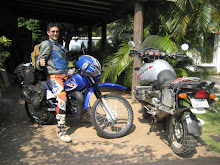
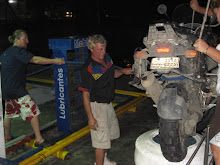
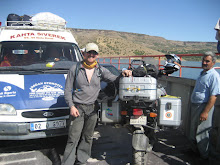
I was late picking up Dave after some difficulty getting my rear tyre changed and after a warm welcome we set off into the worst weather of the trip. It was cold with driving rain and sleet, so after 3 hours we stopped at a non - descript Best Western motel in a non - descript Hope. We showered to warm ourselves up and stop our teeth chattering and then headed out for some warming soup, burgers and beer, accompanied by several rounds of pool, which I let Dave win to help him get over his jet - lag. The next day was freezing cold but clearer and after crossing the Allison Pass, wary of ice, especially as they don't use salt on the roads here so as not to attract animals out of the woods, I started to speed up. It wasn't long before Officer Stockmeister of the Royal Canadian Mounted Police flagged us down and gave us a speeding ticket. He was quite decent about it all things considered, giving us the minimum fine of 138 canadian dollars - 100 for speeding and 38 for each KPH above the speed limit. He also explained that we had 30 days to pay or contest the ticket, so looks like I won't be paying that one then and will be adding British Colombia to Turkey and Australia to the list of places where I am wanted for unpaid speeding tickets.
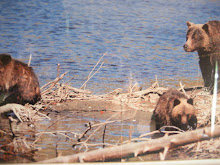
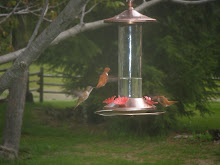
Along the border, seeing lots of joint US and Canadian flagpoles, interestingly not something I noticed south or north in Alaska on the American sides of the border. We arrived in beautiful Kaslo set on the long vertical finger of Lake Kootenay and starting seeing black and grizzly bears on the road along way. Julius and Kristen, owners of the Grizzly Bear Ranch greeted us and we met Davey and Julie and Timon and Lisa at dinner. Davey was a retired fire officer and Julie was his younger partner, both were good company, whilst Timon (presumably named after Shakespeare's least popular play?) and Lisa were a couple of Actuaries who maintained the reputation of the profession as making chartered accountants look interesting. Next day we went bear watching together, also seeing plenty ofwhite tailed deer, mule deer, elk, a Bald Eagle and an Osprey. Most surprisingly, there were tiny, buzzing migratory humming birds in the garden, which was patrolled by Koro and Masher, the ranch's two Alsatian bear - dogs. They went bonkers one evening and we rushed out to see a black bear on the opposite side of the river that runs past the Ranch being warned off.
Julius (an ex - War Reporter) and Kristen (an ex - Diplomat's wife) regaled us with tales of the locals in the surrounding area, which is renowned for pot growing. Their neighbours on both sides, O'Shea and Dibble seemed to be doing a great job in keeping up the reputation of backwoodsmen for drunkeness and excess. One day, Dave and I joined Duff (nothing to do with the Simpsons, that was his real name) and Suzanne from Johnson's Landing for a day kayaking on the lake, which was great and a nice break from being in a big group. We stopped on a beach for lunch and Duff revealed himself as a conspiracy theorist sans pareil. His favourite themes were about Chem Trails and Con Trails, which are being used bu the government to control the weather and as communication mechanisms, and this "must be true" because Beck has just realeased a song about it. More convincing were his references to Building 57, the 3rd tower that was demolished on 9/11, but which no-one seems to know about and references to the film, America: From Freedom to Fascism, which is actually a very good, thought provoking film about who ruled the USA in the twentieth century.
Anyway, all to soon it was time to say goodbye to Dave B at Castlegar Airport and I headed north to Kelowna to see about my clutch. The people were very nice at SouthWest Motorrad and after suggesting I wash the bike they thought the gear oil level was just overfilled and so was splashing around. They helped me to drain the level, gave me a T-shirt and sent me on my way having saved me a tidy sum in unecessary repair bills. They also said they would keep hold of the clutch and send it onwards as an when I may need it. I headed north, now a day ahead of where I thought I would be, and made it to Prince George for a night in a bog standard motel.
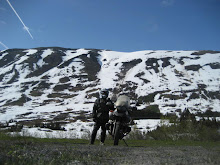
The road out of Prince George, Highway 16, is a noticeably quieter "highway" and I start to recognise the other travellers on the road, seeing the same people throughout the day. There is the redneck in his green Ford truck with the Leer trailer cover, the double trailer petrol tanker, reassuringly heading north, the old couple in the camper van and Greg, the biker from Vancouver. Names here are strange too. Yesterday I was heading for Williams Lake and Prince George and today I am heading for Watson Lake and Prince Rupert. For anyone who like me is a fan of the Simpsons, Burns Lake and the next town along, Smithers, would also raise a snigger or two. I stop in the Tim Horton's in Smithers and meet Talking Bear, an enormous Gitivangak Indian who was riding an even bigger Triumph America. He gave me what appeared to be some good guidance on the fuel situation ahead on the Cassiar Highway. There was fuel at the beginning at Kitwanga, then at Meziadin Junction and 333 km later at Dease Lake according to Talking Bear. He also guides me to the ring of mountains that surrounds the town, still crested in ice and snow even though it is the middle of June. Once again the names are funny - along with Mount Cronin and the Seven Sisters Mountains, the biggest one nearest town is called the Hudson Bay Company Mountain, no doubt named by some brown - nosing pen pusher in the 18th or 19th century.
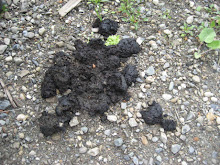
Immediately I get on the Cassiar there is loads of Moose Scat in the gravel on the road and an enormous blood stain on the road surface, indicating both just how enormous these beasts are and how dangerous it is to hit one. The flies are getting thicker as I pass through dense forests of fir and the strong raina and sleet showers become a temporary relief as it affords the opportunity to clean my visor off.
However, when I get to Meziadin Junction there is no fuel and the station is all shut up and the pumps wrapped up in tarpaulins. I go to the nearby campsite to see if anyone has any fuel I could buy, but there are only a friendly group of cyclists who suggest I get off the road and go to Stewart, 59kms off the Cassiar Highway and right on the southern border of Alaska, butting up against Hyder on the Inside Passage. It was marked as another unsurfaced road on my map, but I had little choice but to try it out as I had already done 170km since Kitwanga and didn't have enough fuel to make it to Dease Lake. Even though when I got there the petrol station was shut for the night, the ride alone made it the best enforced diversion ever. The birch trees fringing the road and the lakes and rivers shimmered in the strengthening wind and sun as the clouds dispersed and revealed a deep sapphire sky. The mountains stand firm in their icy fastness with the lowering sun glinting off the glaciars. The biggest of which, Bear Glaciar, has fingers of blue ice that reach down the edge of the road itself. Like runnels of white - hot lava that have cut through the stands of Douglas Fir, Cedar and Larch that cling to the precipitous mountain slopes, the scene is mesmerising. Only the plethora of black bear feeding off the sage and dandelions on the side of the road focuses me on the road ahead.
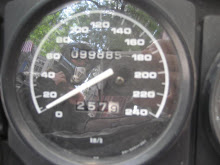
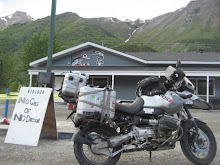
In the bar in the Stewart Hotel, I meet a bunch of BIH Miners, with black faces and dirty overalls who have been off road and helicoptering into some of the old mines. They explain that the rising global commodity prices have encouraged their company to send teams like theirs into some of the disused mines to recover previously uneconomic ores. I started out the next day, cold in the shade of the mountains and soon realised that the bumps of the rocks on the road had snapped my speedo and odometer cable. I was stuck at 87417 km, and I stopped and fiddled around at the Rabid Grizzly rest stop (honestly that was its name!). I was initially stressed out by this, as my LED fuel indicator had broken on a similarly rough section of road around Lake Atitlan in Guatamala and I had been relying on the odometer to predict my fuel range. Now that was gone and some of the longest inter - fuel sections and the most remote roads were just about to come up, the Cassiar being a case in point. Also, my rider display now looked a sight, as my ABS red warning lights flashed constantly (broken in Argentina), my LED didn't work at all and now only my rev counter worked amongst my clocks. I was also pissed off because I was hoping to cross the magic 100, 000km mark on this trip, by far the longest I have ever ridden on any of my motorbikes.
The stress disappears as I realise that I have nothing to prove to anyone apart from myself on this journey and this has always been a thing with me that I have recognised for a long time. I always seem to strive to collect certificates and awards as a way to get the recognition I craved as a kid. I have got to know myself so well on this trip and I have nothing to prove to myself after making it this far, that I don't feel I have to do anything I don't want to do. Maybe I am starting to grow up a bit and just like Jack London in 1897 when he joined the Klondike Gold Rush when he said "It was in the Klondike that I found myself. There you get your perspective. I got mine". I carry on for a great day's ride through the most remote road I have been on so far. You know you have been through somewhere isolated when you see more bears than other vehicles on the road and more moose than people you have conversations with, including the people at petrol stations and the motel.
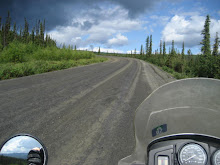
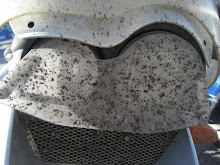
The mud and gravel sections were slippery and wet with the road tyres on and the petrol staion at the ironically named Good Hope Station is also shut. I run out of petrol before getting to the junction with the Alaska Highway, but like everything that day, I take it in my stride adn thanks to the litre or so of fuel in my camping stove bottles, make it with fumes left in the tank. I meet Bellingham Bill and Simon from San Rafael on their KLRs at the petrol station heading in the opposite direction. They tell me about the onward road conditions, although they point out that there biggest challenge was the flies that got bigger and thicker the further north you went. They show me their radiator grilles that looked like someone had just taken the top off an Eccles Cake as testament to this. Still feeling fresh, I quickly polished off the last 464 kilometres into Whitehorse in just less than 3 hours into the setting sun as I headed north east, mostly on tarmac now, over sparkling lakes and the glinting slippery surfaces of the metalled bridges of the Yukon Territory.
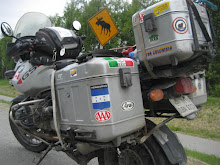
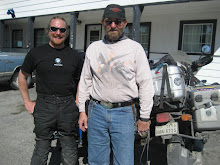
I get to Whitehorse to find all the hostels and motels full. At one motel, Ron, a Harley - riding Vietnam Vet and muppet look - a - like, flagged me down to say that my box was hanging off as I went by. He was just unloading his bike and had noticed the loose strap. By now, all the stupid plastic locks of my BMW panniers were broken and needed to be strapped on and this one had gotten too close to my exhaust during the long day of riding and burnt through. At the office they said they were full and so I went back into town to see what else was available. The answer was nothing, and I was resigned to riding out of town to try my luck on the road towards Alaska, when passing the same motel, Ron flagged me down a second time. Ron Johnson is one of those rare Christians who actually seems to be focussed on emulating the behaviour and philosophy of the religions founder. He offered me a bed in his large suite style motel room and we agreed to split the cost. In Whitehorse there are no generica North America restaurants here, so we went out for a Chinese meal together in a bright and sunny Whitehorse at gone 11pm. I learnt that Ron used to work on the railroad and he had recently lost his wife to cancer and his Mum to old age. I also learnt that not only did he have a face like Ernie from Sesame Street, but he also sounded uncannily like him too.
I am absolutely knackered after 2 tough days of riding more than 1,000kms each day. I have underestimated the distances here and realised yesterday that my Yukon, NWT and Alaska map is half the scale and so double the distance of my previous Canada map. As soon as the food hit my stomach the long day's ride caught up with me and I was ready for bed. Next day after breakfast together, Ron and I said our goodbyes and wished each other well. What a gent. I have been so lucky on this trip to meet so many good people. In fact, I have come to the conclusion that there is no such thing as evil people, there are only bad situations or sick, ignorant or fearful people that get involved in bad things. The thing I don't understand is, why are governments so consistently unrepresentative of the people who I have met that live in those countries?
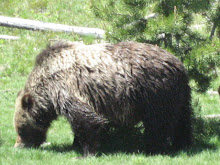
As Albert Einstein and any long distance bike rider know, time and space are relative on a continuum. Now that my speedo is broken and the distances between places are getting longer and longer, I start to measure distance in time and vice versa. I also notice that the grizzly bears seem to have fur to match their surrounding fauna - from cinnamon brown in British Colombia, to almost white around Stewart and and blonde / sandy up north. There have also been reports that bears are attracted not only to food and perfumed smells but also synthetic smells too and there are accounts of them demolishing vehicles to eat batteries, tyres and rubber hoses! I also read one funny story of a group of French hikers who would be hiking away from their vehicle for a number of days and who decided to spray their car with bear - repellent to make sure it would be OK whilst they were away. However. because the repellent is basically made from chillies and is effective in temporarily blinding and confusing a bear that gets too close allowing you to escape, it actually made their car even more of a culinary attraction than normal and they came back to find all the tyres chewed off and the bonnet ripped open and all the delicate little amuse bouche inside taken by the furry gourmands!
Whereas there are estimated to be between 800 to 1000 brizzlies in the lower 48 states. As I approach the border, I read in my guidebook whilst taking a break over a brilliant spicy, homemade pizza, that in Alaska, there are estimated to be between 12,000 to 13,000. These numbers have been declining in inverse correlation as the human population of Alaska has soared from 70,000 to 500,000 people since the second world war.
I pass Haines Junction and eventually cross the border into Alaska and immediately get stuck at the front of a queue waiting for a flagger to let us go ahead. This is frustrating for two reasons. Firstly, I am waiting next to a bloke on a Harley who is talking to the flagger and explains that he has come 3500 miles from Seattle in just less than 2 weeks. She seems amazed at this distance, absolutely stunned that someone could ride a motorcycle that far and that fast. She then asks me hwo far I have come and I say that I have come from Argentina since the beginning of the year and she nods and just says "u-huh" in recognition. I am stunned at her response and guess that she only knows US High School Geography (which seems to be to be able to memorise the State Capitals of the 50 States) but the Pilot Car has eventually arrived and we are off. The section of road is wet, muddy and slippery, but it is not that bad and it is frustrating to have to follow the Pilot Car for nearly 20 miles at 15 mph, the boredom only relieved by seeing the Harley rider skid and buck over the uneven ground in my mirror and to get a great view of a large bull moose crossing a lake. His large palmate antlers are majestic and comply with the rule that they always seem to have 14 points.Whilst the bike is a great place to view wildlife, unfortunately it is not such a great place to take pictures from, once you have fiddled about taking gloves off, getting the camera out, etc then the moment has invariably gone.
I arrive in Tok and manage to get a room in a motel made from portacabins. Although it is getting quite late, it is bright out and the sun is stronger now at gone 10pm than it has been all day. I go for a stroll. I almost wet myself with laughter when I read a poster on the community health centre noticeboard that they have a big problem with ticks in Tok, much to the bemusement of some Tlingit winos who are hanging around the car park. I decide to take Michelle Shock's advice and anchor up in Anchorage for a couple of day's R&R. and get a great viewing of an enormous bald eagle, sat on a bridge railing as I cross it. I get a close up view of his fearfully enormous high - bridged beak and his cold steel - blue eyes as he stares at me on the bike for a few seconds. He is simply enormous and seems like a wolf with wings. Thankfully he decides that I am not worth eating and he flies down to the stony beach below and picks up the moose calf carcass that he was feeding on and carries it off into the forest, easily supporting its weight with its terrifying talons and wingspan that seemed at least 12 feet across. As I get closer to Anchorage there are also some panoramic views of the taiga, tundra and mountains beyond, and I can see for miles as the clouds clear. The air quality is brilliant after rain and I can see Moose in th valleys, Dall Sheep on the mountains, a beaver swimming across a lake and even a family of chipmunks being shepherded just across the road in front of me.
My visor is just caked on with flies and insect debris. It looks like the inside of a perspex mixing bowl that has just had rock cakes or fruit scones prepared in it. Bits of dried fruit and splashes of egg yolk with other indescribable gunk chucked in for good measure - it is also about as transparent too. There are a lot of parallells here in Alaska with being in Patagonia 6 months ago. The flags are similar (mountains and the southern cross on the Patagonia flag and Ursa Minor and the Pole Star on the Alaska flag. There is also the perpetual daylight issue, although that is much more pronounced here. I am having to use my tarpaulin over my tent and the airline facemask that Dave B left with me to be able to get off to sleep. It is also strange here to see everyhting closed at a "normal" time when it is still bright daylight whereas in Patagonia people seem to adapt their behaviour more to fit in with their natural surroundings. Here nature is ignored or expected to adapt itself.
Calcium Chloride is laid on the roads here and rocks too, scattered around randomly from icy patches that have melted since the spring has begin here. They never use salt up here as it makes the roads more dangerous as it draws all the animals out to lick it up! There are lots of delays for roadworks here as they are digging up the road to lay blue felt underneth to try to prevent buckling of the surface in the winter due to the ice expanding underneath. Road from Tok to Anchorage was constantly changing, with a rollercaoster of buckles, gravel and dirt and then some silky smooth new tarmac too, all with a dash of moose to keep you awake. No external stimulants were required on the middle section from Glenallen Junction as the scenery was simply breathtaking, turn after turn after turn. Snow and ice - peaked mountains in the distance and low forest and tundra in the foreground with herds of caribou clearly visible. It was like entering some mystical kingdom, like the legends of Shangri - la. The wind - buffeted cottonwoods and feverfew gave off a wonderful scent too from the side of the road. Small planes in front of cabins on the road between Tok and Anchorage. There was no discernible runways, so presumably they used the road to take off and land.
I get into Anchorage which feels like a teeming metropolis after all the wilderness and tiny hamlets I have been in for the last few days and get a place at the Backpacker's Lodge, courtesy of directions from Arnold a Harley rider I met at the traffic lights. It is cheap (for North America anyway at 50USD), central and clean. I fall asleep almost immediately after I have unpacked the bike and then get up for a walk in the bright evening. After a stroll through town past the rows of gift shops and unhelpful ATMs I stop at a Japanese restaurant to celebrate getting this far with some sushi and Kirin Ichiban. By the time I have finished and walk back to the hostel through the dusky gloom brought on by the rain at gone 1am in the morning.
I can't sleep in my portacabin because the light is streaming through the inadequate ventian blind, so I flick on the television. Inevitably there are loads of medical related adverts on (again playing on American fears that they won't live for ever, it will just feel that way). Straining. Going Too Often. Not going at all. Going when you were not expecting to. Incomplete emptying - which always puts me in mind of an inefficiently run fire drill in a public building, but which of course refers to an altogether different, trouser-dampening reality. The biggest single market is in drugs that deal with erectile dysfunction. My favourite features a group of men who gather together to play in a band. I think it is meant to show them looking relaxed and happy, but they are such good musicians you cannot help noting that impotence has left them with plenty of time on their hands to practise their instruments.
The best part of the adverts tends to come towards the end when the law requires the pharmaceutical company to list the possible side effects of the various products. Sometimes these are spelled out in a warm tone implying this is all a bit of a formality imposed by the fussy government. On other occasions they are rattled out at speeds normally only reached by horse racing commentators in the closing stages of a big race. The symptoms include coughs and sneezes, runny noses and rashes but there is a more alarming end of the spectrum too where you are solemnly warned of the possibility - presumably small - of suffering a stroke, a heart attack or even death - the last and greatest side-effect of them all.
It got up to 10 degrees centrigrade at one point today - and this is summer! In Tok, they proudly claimed that it was the place on earth with the coldest average temperatures in the world at -30 degrees throughout the winter months! I am sure that I have heard of a colder place in Siberia, but I guess they are less concerned about such statistics there... I had a busy morning, running around in the pounding rain and hail on the bike and sorting out my speedo and odometer cable and pin - key thingy by replacing it with a second - hand one from a wrecked RT BMW, Whilst the RT had a 17 inch front wheel and my GS has a 19 inch one, which should mean that it underestimates my speed and distance, at least it is working again despite having about 5,000 uncounted miles since it went on the Cassiar Highway last week. I then enjoyed another fantastic afternoon nap, did some stuff on the internet the weather cleared about 9pm with bright sunshine streaming through the thinning clouds and then enjoyed an evening walk along the Tony Knowles coastal path to Lake Hood to watch the sea planes take off and land.
I am beginning to warm to Anchorage as the weather improves. The people are all warm and friendly and Alaskan Ales IPA is one of the best beers I have ever tasted. All of which, along with Lena's advice and reading about Buck's problems heading north without enough rest in "The Call of the Wild" lend me to considering staying here a while longer. Walking around in the late night sunlight I also start to appreciate the town's architectural merits too. Most of the public buildings date from the 1920's and 1930's and so are heavily Art Deco influenced. The cathedral is a fine example and must be one of the few Art Deco churches in the world.
The residential areas vary from smart to ramshackle wooden buildings, sometimes traditional cabin, sometimes chique modernist statements in clapperboard and clinkers and sometimes without any distinguishable style whatsoever. All are charming though and surrounded by trees and often painted in muted sages, greys and cinnamons, which gives the city an overall low -rise, low impact impression with Cook Inlet and the mountains beyond dominating. Ushuaia and Anchorage are the polar twins of each other. Surrounded by mountains and the sea, perpetual light in their respective opposite solstices and a cold, dampness. Gift shops and cruise passengers during the day and raucous nightlife thereafter.
Captain James Cook arrived here on his third and fatal journey on the Resolution in search of the North West Passage. He failed and instead of finding the long sought after route, which now due to global warming is becoming a reality, after leaving here and reaching Hawaii, he fell sick and died. Another song I am singing in my bike helmet iPod - on the way here I added "Anchorage" to my repertoire and since arriving here I now have been thinking more and more longingly of being with Lena and in the more or less perpetual daylight the Kinks have been rolling through my head "girl, I want to be with you all of the time, all day and all of the night" seems particularly appropriate. I notice that Anchorage also has the same cruise - crowd who flow in and out like the tides, wearing the same branded red anoraks as each other and their counterparts at the other end of the Americas in Ushuaia. No crowds of feral, free - running dogs here though, even though Anchorage is the start of the annual Iditarod dog - sled race. The tens of thousands of gold seekers who rushed to the Klondike learned quickly that only dogs could survive and serve as the major form of transport here, as attested by the carcasses of dead horses and mules that covered the trail. This is also well documented in the attempts of Amundsen and Scott in the Antartic and their relative success using dogs and mules respectively.
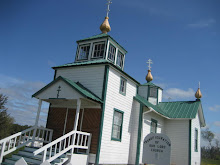
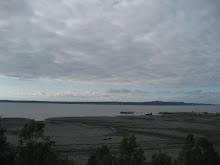
I take a ride out along the Kenai Peninsula to Homer (why is there such a strange link between NW place names and The Simpsons?) and stop by on the way to see the Russian Orthodox Church and beach in Ninilchik, looking across Cook Inlet to the Aleutian Range. Around the Turnagain Arm, allegedly named by Cook as he thought it was so broad and grand an entrance, lined with glaciated mountains, that it must be the entrance to the Northwest Passage. It is in fact an estuary and so Cook had to turn around (again), but its grandeur is undeniable. The next day after a great short order breakfast at the White Spot Cafe, I was packed up and off to Denali National Park.
I get stopped by a flagger again along the road, and whilst we wait, she offers me some spicy and gamey moose sausage which was very tasty. She also explains to me that just as Arabs have many names for sand, Alaskans have many names for flies. Everyone seems to know the cycle of seasonal hatchings intimately and she explains that the big spring female mosquitos are now in decline and the small, almost invisible stinging "no - see - ums" are just about to hatch out. Thankfully the pilot car arrives and I am off, leaving the annoying cloud of flies behind - they seem to gather whenever you stop for a few seconds. As I head north to Denali, I realise looking down at my map that there are no more intercity roads west of here for more than a thousand miles all the way to the Aleutian Islands. Should I stop in lower Alaska for the solstice bike rally or head north through the wilderness on thousands of miles of unsurfaced roads amongst the wildest wilderness on the planet and guaranteed close encounters of the furred kind?
Tuesday, June 17, 2008

Tuesday, June 10, 2008
Up North of the Border
Today was possibly my best day's riding ever. Starting out at dawn from Beatty Nevada, I headed west on the 374 State Highway, with the rising sun behind me and the setting moon and multicoloured Death Valley ahead of me. Absolutely no-one else there at all and I zoomed along the smooth as silk tarmac surface, which curved up and down and round and round. I crossed the Panamint Range, with 3 valleys and passes in between, dropping to 625 feet below sea level at the bottom of Death Valley and up to more than 6,000 feet at the top of the last pass. I diverted off the road to get some gravel action towards the colourful Mosaic Canyon, wit it's colourful split rock formations. I got a great view of the grey granite and limestone of the appropriately named Sierra Nevada ahead of me, with Mount Whitney and its sheath of snow clearly visible. Passing Panamint Springs (now in California) I followed the road towards Lone Pine, skirting the salty expanse of Owens Lake. I saw a sign for a Sulfate Road and saw the road heading straight across the lake> I went for it and satisfied my frustrated desire from Bolivia, to do some more salt flat riding and headed on to Lone Pine. Tried to fill up with petrol, but was frustrated and continued to Bishop for a great sandwich at Erick Schat's Swedish Bakkery. Due to the time difference I felt like I had ridden all day, but it was still only 11am, before heading west through Yosemite.
Met George and Alberto at Erick Schat's Swedish Bakkery, Iraqi Veterans heading home to Reno for Memorial Day. They were riding 2 well used hand custom Harleys, and had been all over the USA since they had left the army last year. George had been shot in the leg and seemed to have recovered physically pretty well, although judging by the way they both smoked constantly, pulling hard on each tab right to the end, it seemed that mentally perhaps they were still in some recovery. They had noticed my Iran sticker and wanted to know what it was like to travle there as they were interested in travelling more around the world, now they had seen the States in some detail. They also helped me out with some tips for Alaska too. They asked me what type of gun I was carrying. Shocked when I said none and wasn't planning to either, they strongly suggested that I buy a big can of Bear Mace as a last resort defence.
First to pass over the Tioga Pass, 3031 metres high, into Yosemite from Lee Viney since they shut it in October 2007. It was now May 22nd and I was amazed how much snow and ice was still there. I was lucky enought to see Ranger Chuck Brown switch the sign over from "CLOSED" to "OPEN" on the turn off and went for it. Snow and ice were still on the road, although most of it had been pushed into banks on the side of the road. Ten or twelve feet deep, the banks were well above my head and I felt great breathing in the clear fresh air through my balaclava (getting its first use on the trip) enjoying the breathtaking views of the forests with the solid rock mantle of El Capitan soaring above. I had to pay some attention to the road however, as there was still some snow and ice around and as I had found out from George and Alberto, in National Parks and throughout Alaskan state highways, they don't use salt on the roads as it attracts the Moose, Elk, Wolves and Bears and such out to the tarmac to lick up the much needed mineral and so increasing the liklihood of accidents and unwanted "interactions" with humans.
In a car you always see things from inside a tin box that has a wheel in each corner and a windscreen that provides a frame that trammels your view of what you are passing through, like a TV or a film. On a bike you are in complete sensory contact with everything around you - the temperature, the smell, the feeling the touch of the surface of the road against your tyres, the unrestricted view of what is around you and if your mouth falls open agog at the wonder of it all, you can also experience the remarkable taste of lfies too! Despite the advent of iPods and intercom systems and the on board entertainment system of the Honda Goldwing, by and large, a motorbike is the place from which to meditate and contemplate your surroundings from. You can do this at your leisure without pressure of time and without the feeling that you ought to be dong something else. My bike swings through each corner with a natural ease as the bike leans and plunges and soars through all 3 dimensions and I shift my weight so that it is always between me and the tarmac. The way is full of tight turns and sudden views of a cove below, with foaming spume being drawn over the pebbles by the receding tide or black cherry stalls appearing in the occasional turnouts. Slanting slate shadows, angled low in the approaching evening through the dry red country left a beautiful blue melancholic feeling as I zoom around the San Francisco Bay and over the enormous Richmond Bridge, with the Golden Gate silhouetted by the setting sun to my left.
Having arrived to a warm welcome in San Rafael to stay at Maggie and Gaby's, we take a trip to City Lights, a San Francisco establishment was a great place to browse. Founded in 1953 and the first to publish many of the Beat authors, including Jack Kerouac's iconic "On the Road". It was the USA's first all paperback bookstore and retains the higgledy - piggledy structure of a second - hand bookseller along with imaginative and radical title selection missing from the big chain stores and a gently persistant pressure to "sit down and read a book" from a plethora of signs. Then we wandered around China Town, before settling down for a couple of Guinness (best on the trip so far) at the Irish Wall pub. As the evening approached we enjoyed a great pizza at Cafe Zoetrope before popping across the road to catch the early set from Houston Person and a Montenegran pianist that Maggie recognised and had a chat with afterwards. We were at the cosy, red velvet cavern that was Jazz at Pearl's. No doubt the smooth saxaphone acoustics were aided by the soft furnishings. The overall atmosphere was topped off with the neon Friday evening cityscape in the background and the striking perpendicularity of the downtown area behind, along with the crossed street signs of Colombus and Broadway outside the window.
Next day we went out to Muir Beach for a bracing walk and visited the nearby Pelican Inn for a couple of resotrative ales by the fire. That evening I went out with Albert and some of his friends to the Edinburgh Castle and then stayed at his place. One of his friends, Seth, told me a great story about the Bay to Breakers run they had completed the previous weekend. Whilst there are a group of hard core runners who take the event seriously, most are in it for fun and there is a lot of dressing up. The funniest and most famous is the Salmon Run Club, a group of surrealist "runners" who dress up in salmon outfits, start at the finish line and aim for the start, "swimming" against the flow as they go! San Francisco originally called Yerba Buena by the Spanish, and I certainly smelt a lot of herb in the Edinburgh Castle and saw the most cocaine in the toilets since Colombia. Maggie, Gaby and I enjoyed a day wine tasting in the Napa Valley, visiting Viansa, Mondavi, Opus One, St. Suprey and Beringer.
The next day, I went for a ride in the rain to Point Reyes Station on HIghway One, which despite the weather was a great run, especially going through the redwood forest glade on Lucas Avenue that the eponymous Director used for the jet - bike scene in Star Wars 2: The Empire Strikes Back. Highway One is famous south of San Francisco, but I thought the northern section was pretty remarkable too. We had a great visit to Fort Point at the base of the Golden Gate and then across the soaring ochre span to explore the new hotel, Cavallo Point at Baker's Point on the opposite shore of the mouth of the Bay. We also spent some relaxing evenings in watching great comedy at Maggie and Gaby's - Tracey Ullman, Margaret Cho and Dawn French - Girls Who Do Comedy and Boys Who Do Comedy, mostly on You Tube. The internet is changing the way people watch TV and I think the quisling BBC in particular, are in for trouble. Their pricing model, based on enforcement for everyone who has a TV set is completely out of date as you can watch their programmes on Youtube instead for nothing on your computer. Eventually, the morning came for me to leave after a great time with the Kalifornia Krew and I left early after being woken by the racoons rattling in the rubbush bins in the drive.
Listening to a couple in a diner when I stopped for lunch, I think that Americans feel fear and because they don't understand the world, they lash out at what they do understand - their fellow Americans. The country is polarised and different sections of the population seem unreconcileable, whether their differences are about race, religion or gender. If Eric Hobsbawm was still alive he would write a history book about the last 25 years forward into the next decade at least called the Age of Terror. There are plenty of alternative Americans who seem to understand the situation clearly and even have a sense of humour about it too. This is the land of the bumper sticker and I saw a great one the other day that made me chuckle. "My country invaded Iraq and all I got was this expensive gas!".
Following the Eel River Valley north, taking a diversion to go through the Avenue of the Giants. I felt small and light due to my surroundings and my new light packing, having left the remnants of Neil's gear and a load of my books and some worn out shoes and clothes that I had finished with.meant that I was now travelling light, with space for Dave B and Lena to ride pillion. I have entered the land, thickly wooded mountains and river valleys, of the Sasquatch or Bigfoot. Stayed in a motel next to a micro - brewery between Fortuna and Eureka (no sign of Archimedes). It was cold and damp and I realised I was going to have to get some more cold weather clothing as well as the bear spray and maybe some deer whistles too, as that morning I had seen my first Elk.
North along Highway 101 now with gradually increasingly frequent and longer glimpses then full splendid panaoramas of the North Pacific through the rolling hills, thickly covered by the giant coastal redwoods, with a light fog of spume and spray covering the coastline in a hazy veil. Stopping for lunch in a roadside diner, I ordered local grilled chinook salmon and the large, flat - faced waitress fussed over me and we chatted for a while, she being interested in the novelty of foreigner as I had left the cosmopolitan Bay Area far behind, and I was glad of the company. We chatted about healthcare of all things as she had heard of the NHS, telling me horror stories of people falling ill in the reatuarant, being picked up in an ambulance, taken to the local hospital 5 miles away and charged 18,000 USD! She was a member of the Chilula tribe who funded their own clinic and that is where she went for her regular doctor's visits, eye care and dental work, although she still seemed fearful about getting a serious illness. She said she was thinking of moving to Alaska (telling me how beautiful it was and not too cold around the Inner Passage in the south - east) as the State offered free healthcare to attract more people to settle its deserted wilderness.
Onto the Redwood National Park and along a gravel track past herds of Roosevelt Elk and arrived at the empty Gold Bluffs Beach campground. I set up the tent and gathered some firewood for later, finding an enormous laterally cut log from a Redwood, much larger than the wheels of my bike. Rotten in sections along the sapwood but as hard as granite inside and outside this on the cambian layer and in the heartwood, I nevertheless soon split it up with my handy hatchet. Bleached on the outside, the new wood shone like damasked satin, burnished an irridescent coppery red as I split it along the grain. Then I headed up the hills towards along the Miner's Ridge trail, feeling dwarfed by the giant trees. Lots had fallen, as for all their size above ground their roots only penetrate upto 12 feet deep. although they do spread wide and their cones are relatively tiny too, creating clearings where I sometimes glimpsed more Elk, but I was deliberately making noise as I walked to give the native Black Bears plenty of notice of my arrival. I explored the remains of the Gold Mine and camp and then came back to the beach, noticing how the undergrowth was also full of relative giants too. Massive clumps of clover, like enormous three leaved umbrellas must have drawn the elk into the forest. In a couple of months the berries would do the same to the Black Bears, as the bramble blossoms were as big as dog roses. There were also swathes of wild blue lupins everywhere too, reminding me of the same sight in the Southern Hemisphere spring in the Parque de los Alerces 6 months ago now.
It was a sombre scene, as dusk approached and a bank of tall grey clouds advanced across the shore and I saw that I still had the whole site to myself. I lit the fire and munched on some roasted almonds and candied ginger, still full from my big, late lunch. Then I went for a walk along the beach, accompanied by seals and pelicans parallel to the shore, the former 10 metres out in twos and threes and the latter a hundred metres out swooping over the breakers, always maintaining exactly the same distance between themselves and the broiling water. The sea was getting rougher and there were some vicious riptides along the shore. The loneliest thing on the beach was a big wooden pole driven into the sand, with lots of momentos left around it and some Native Indian ribbons and fetishes. I came back to the camp to find a note from the Ranger, informing me that "vehicle needs to be moved to designated parking area outside of individual campsite". I pushed my bike the requisite 5 metres, glad that my the mysterious jobsworth had shown me the error of my ways in a public campground I had all to myself!
I read by firelight and then when it got too dark I played my mouth organ as the doleful (and dreadful) notes floated up into the starless, moonless sky, following the billows of smoke from the fire. Distant thunderheads reared quivering against the electric sky, silently behind the roar of the ocean, before being suddenly sucked away into the velvet darkness again. I saw strange shapes of blue in the salty gloom about me as the lightening flashed without any sound above the din of the waves and never with any rain. My silver bike, the white toilet block and I could also make out the nearest, biggest trunks from the forest line between me and the beach, although mostly it remained an impenetrable dark mass. This, despite the intense periodic flashes of lightening making staccato glimpses of blue illuminated days from the night, which always returned to its curtained darkness.
The brief flashes of the surrounding bluffs, forest and sandy links revealed the landscape in its true geology; not of rock, water, trees, salt and sand, but that of the fear of being alone. I was comforted however by the fact that I was enjoying the loneliness of my situation, I just yearned to be able to share it with Lena and so I made do with this poetic description instead. I packed my food into the bear - proof container provided at the campsite and went to bed. Without this, I read a poster outside the toilet block which said that all food, rubbish and scented items - soap, toothpaste and lotions - would have to be bagged and taken 200 feet from where you plan to sleep, hoisted at least 12 feet up a tree and 10 feet out from the trunk and five feet down from the branch to keep it out of the reach of bears. Just take a moment to think about theses distances and see if you got the same chill down your spine to think of the sheer size and power of these beasts. I leave the campsite in the morning, riding along the dirt trail along the seashore, past the dessicated, bleached hulks on the beach. Like leviathan logs beached on the sand. Further on, magnificent bull elk, brooding 2 hundred yards away from the cows and calves for another few months until the rutting starts. It was a beautiful place.
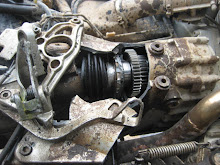
The Coastal Redwood is world's tallest living tree, monarch of the NW Pacific coast and one of the only living links with the age of dinosaurs. A redwood grows from a seed the same size as a tomato pip and yet can weigh 500 tons and reach nearly 400 feet high when fully grown, which takes a mere 2,000 years or so. The shorter, stouter Sequoia can weigh double that and can last more than 3,000 years - that's a lot of rings for someone to count. Its full latin name is Sequoia Sempervirens and means everlasting Sequoyah, a famous cherokee leader. Both species can survive forest fires and the attacks of insects thanks to bark layers which can be more than a foot thick at maturity. Later that day, I was stopped by Trooper Katzakis of the Oregon State Troopers and warned in a friendly, efficient and professional way about my speed but not asked for my non-existent insurance. I resolve to get this sorted on the internet as soon as possible. Soon afterwards, whilst pulling up at roadworks, I hear a "ping" as the spring on my left throttle body snaps and my left throttle cable is stuck open. I make it the 40 - odd miles north to Newport, Oregon by riding slowly and switching the engine off when I need to stop. Tired and cold, I check into the Best Western and resolve to get up early the next day and try to:
1. Fix it myself
2. Ride it to town and get it fixed here
3. Ride it to Salem (the nearest BMW dealer) and get it fixed there, approx 70 miles and want to avoid city riding if possible
4. Ride it to Portland (the biggest BMW dealer) and get it fixed there, approx 150 miles and want to avoid big city riding if possible.
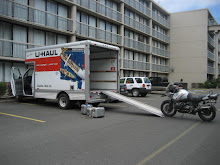
Also if I can't fix it myself, then I only have tomorrow to sort it out as am meeting Dave B in Vancouver on Tuesday, otherwise will have to hang around until next week and potentially miss him or leave the bike and hire a car instead!? After some advice from Neil on the phone I try to re-bend the spring with my Leatherman tool, but only succeed in snapping it further. I find out about the cost of transport and am shocked that everyone quotes more that 500USD, so I hire a U-Haul truck for one day, one way to the nearest BMW dealer in Eugene, Oregon for 114USD plus the cost of petrol.
After realising that I can't fix the broken spring as it is sealed onto the throttle return ring and when I dismantled it as much as possiblee and started trying to bend it, the spring snapped some more. So, after calling BMW of Western Oregon and they have a new part, so will head over there and see what they can do for me there - I guess it means I will be here again tonight, but hopefully should be on my way tomorrow to meet Dave on time. On my way over I feel lucky that at least it didn't happen in Alaska - I would have been bear bait, or worse, nibbled to death by blackfly! The blokes at the hardware store and U-Haul agency in town were friendly and helpful and I am soon on my way in a big van, with a ramp, automatic gear lever on the steering column and exclusively country and western on the radio.
I left Newport at 1.30pm after sorting all that out and thanks to the 55 mph speed limit throughout Oregon, I got to the BMW place just before 5pm. They fitted the left body but pointed out that the right is pretty worn too, so I overnight in a motel and get the right replaced too, as I don't want it to go in Alaska where there are no U - Haul Trailers / BMW dealers around, nor threaten my rendez - vous with Dave or more importantly with Lena in just a few weeks. Mark Ledger the Service Manager of BMW of Western Oregon in Eugene, was a rotund, friendly good ol' boy who squeezed me into his busy spring service schedule. He also pointed out an oil leak between my gearbox and engine casing and suggested that this was an indication, along with the mileage on my bike (84,000km) that my clutch needed replacing. This concerned me, given the riding ahead and the fact that I had just left the spare clutch that Neil had at Maggie and Gaby's place just a few days ago! Over the next few days, Maggie helps out bigtime by not only sending the clutch on to a place in Canada for me, but also helping out with arranging my overdue insurance too.Once it is done, I head straight for the border on Interstate 5,and make it through busy Seattle to another generic motel in Everett.
At Kalama, Washington, I cross the river where Lewis and Clark met the Pacific after setting out from St Louis years earlier on their mission from William Jefferson. From Portland up, the C&W rednecks have disappeared again and a chilled out, wacky metropolitan vibe has taken its place for the first time since San Francisco, where all the love children and beat generation from California seem to have ended up. Everything is drive through in the USA (or should I say drive - thru). I hate that - you know if they don't like the English language, then they shouuld choose another one to abuse. My biggest bugbear is "tire" instead of "tyre", as not only is this mis-spelt, it is also a completely different word! maybe it will be Spanish in a few years anyway. I aso hate the drive thrus, because my cashpoint card is proving unpredictable in the USA and Canada and it is odd to be stood in a queue for the ATM on foot when everyone else is in an enormous truck!
Free coffee and wi-fi on the rest areas, well at least in theory as the volunteers who ran the coffee stall couldn't tell me why there was no internet connection, despite the official signs on the highway. Service was available in the nearest Starbucks along the road, although I was informed that I woud have to pay 8 USD per day to get access, which along with 5 dollars for a coffee, seemed a bit steep. I have found that whilst the USA may like to call itself the most connected country in the world, particularly on the tech - dominated West Coast, it is not so easy for visitors. Even the Starbucks in Mexico City had free, open access internet for customers and not surprisingly, it was packed. At the rest area I met Brendan and Lee, 2 engineering students struggling to undo their beer bottles at the rest area, wandering around trying to lever the top off on the side of the picnic tables, rubbish bins, door handles. I showed them the trick that Yan tought me, employing the engineering principle of leverage, and got chatting with them for a while over one of their beers they offered me. They had been in Seattle for the night to watch some internationally famous DJ perform at the big stadium downtown (?), hence all the traffic jams the previous night. They were heading back to Vancouver, seeking to top up the beer buzz they had attained previously before ging back to college the next day. They were nice blokes and I saw them intermittently along the road and the queues at the border on the way to Vancouver.
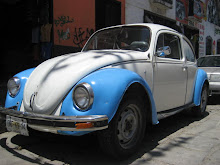
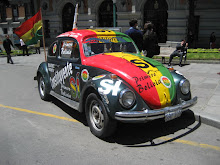
Everybody shouts in America - Generica. So, as a consequence, you get to hear a lot of other people's conversations. Amazing how banal they are, when the closest race for the nomination of the Democratic Party is happenning and the country is the most embroiled in a war of terror, most conversation is about gas prices (average now over 4 USD per gallon). Now people stop me and ask me not about where I have been and my journey so much (I don't think most people here recognise so many of the stickers on my bike) but about the fuel efficiency of my bike! Also, everyone seems so socially isolated here from all but their immediate friends, family and companions, that no-one wants to talk to you, even when they are checking out the bike and I am nearby smiling and trying to look approachable. BUT, as soon as I am away from the bike and in a cafe, bar or restaurant, a crowd gathers round to look closer, poke, point and stare. One exception to this in the Motel 6 in north of Seattle, heading for Vancouver. I had parked my bike next to a funky pink and white beetle. When I came back in the morning, a note was left on the bike which said "I would have been so happy to listen to your stories - sorry I missed you!"
Into Canada and the place names (New Westminster, Richmond and Victoria) immediately became more familiar. As did the face on the back of the notes and coins, with a much more honestly aging portrait of that German woman who sits on the British throne. Unlike British Subjects though, Canadians have voted to become Citizens. Canada so far looks familiarly like suburban Britain, especially if it were ever to become more integrated with Europe - all the street signs and notices are also in French, the metric system has resumed again after imperial USA and the currency is also different, but everything else is essentially the same.
First impressions of Vancouver are pretty good, although its attraction as the best place in the world to live must be statistical, and you know what I think of those by now. There are no particularly iconic sights or monuments, but some of the older buildings, the art deco Marine Building and the Canadian Pacific Railway Station in particular, are pretty impressive. Granville Mall is a pretty alternative place, full of pubs, clubs and "street" shops although my wanderings into East Hastings Street revealed that was the true heart of the city's streetlife. At 7pm on Sunday evening, there was a lot of pavement dealing going on, trade to attain access to other people's bodies and to get the means to get out of the physical restrictions of your own body. There were also loads of homeless, especially trolley people, in Vancouver, in greater concentration than I had seen anywhere else on the entire trip. This is remarkable on a number of points, firstly just given the relative wealth of Canada and Bolivia or Nicaragua for instance, but also it is unlikely that these people would concur with the oft - touted statistic about this being the best city to live in the best country to live in the world in terms of quality of life. That is unless it is also true amongst homeless circles and homeless people relocate to Vancouver, as they seem to in San Francisco, because of its relative attractions. What is also remarkable here is that there seems to be an equality of lack of opportunity here as far as misfortune is concerned. Men, women, whites, blacks and unusually in my experience, Asians, approach you with their blank eyes, "spare change" mantras and hauling trolleys of equally tangible physical and mental baggage behind them through the streets.
There is also lots of conspicuous consumption in the city too. Along with the middle - class rebel kids and weekend warriors hanging out at the bars on Granville Mall, there are lots of Porsche and Ferrari owners cruising the streets, displaying the benificence of Ganesh in a ritualistic way, bringing their spoils back to the maw of Mammon in thanks and glory to their fellow vistors and the shabby hordes of the vanquished on the pavement. There are lots of high - end shops in the centre too, along with lots of book and record shops, which I would be very tempted to browse through if it wouldn't lead to frustration due to my lack of luggage space. There are also more coffee shops here than I have ever seen anywhere else. Perhaps there is a symbiotic relationship with the street people, as they all need an empty coffee cup to hold out for donations? Blenz, Tim Hortons and Starbucks are on almost every corner, often right next to each other. The city is also noticeably another very cosmopolitan urban island, after leaving San Francisco and spending a week in the conservative North American hinterland, with all types of food, drink and substances easily available I opt for an Indian accompanied by some Anchor Steam Stout.
Looking around Gastown I come across the saloon of Gassy Jack Leighton, after whom the district was named. He is remembered for rowing across the Burrard Inlet and offering a group of thirsty workers at Stamps Mill all the whisky they could drink if they helped him to build a bar. Within 24 hours the Globe Saloon was finished. A statue of this famous yorkshireman standing on a whisky barrel is in the Maple Leaf Square, with his second bar behind hom, built in the same way.
Canada, British Colombia and Vancouver in particular like to market themselves a lot. A marketing shop on the border where I bought a sticker for my bike in record time. Even the licence plates for BC say "Beautiful British Colombia" and all the city corporation trucks say "The Best Place in the World". It is certainly a nice place, but not the best in the world in my opinion. Apart from being pretty expensive all over I resent choosing something in a shop, bar or restaurant and then having lots of different taxes added afterwards. Most galling was the hostel bill, which, amongst other state and city taxes, had one charged at 2% by British Colombia for "marketing". When I quizzed this, I was told it was a new one charged on tourists for marketing the state to them in the first place! I am not someone used to paying taxes and expect value for money when I do, but I thought this was just incredibly cheeky. Off to get my tyre changed and then meet Dave B :-) at the airport in the rain:-(, in what would turn out to be the worst weather of the whole trip so far.
Met George and Alberto at Erick Schat's Swedish Bakkery, Iraqi Veterans heading home to Reno for Memorial Day. They were riding 2 well used hand custom Harleys, and had been all over the USA since they had left the army last year. George had been shot in the leg and seemed to have recovered physically pretty well, although judging by the way they both smoked constantly, pulling hard on each tab right to the end, it seemed that mentally perhaps they were still in some recovery. They had noticed my Iran sticker and wanted to know what it was like to travle there as they were interested in travelling more around the world, now they had seen the States in some detail. They also helped me out with some tips for Alaska too. They asked me what type of gun I was carrying. Shocked when I said none and wasn't planning to either, they strongly suggested that I buy a big can of Bear Mace as a last resort defence.
First to pass over the Tioga Pass, 3031 metres high, into Yosemite from Lee Viney since they shut it in October 2007. It was now May 22nd and I was amazed how much snow and ice was still there. I was lucky enought to see Ranger Chuck Brown switch the sign over from "CLOSED" to "OPEN" on the turn off and went for it. Snow and ice were still on the road, although most of it had been pushed into banks on the side of the road. Ten or twelve feet deep, the banks were well above my head and I felt great breathing in the clear fresh air through my balaclava (getting its first use on the trip) enjoying the breathtaking views of the forests with the solid rock mantle of El Capitan soaring above. I had to pay some attention to the road however, as there was still some snow and ice around and as I had found out from George and Alberto, in National Parks and throughout Alaskan state highways, they don't use salt on the roads as it attracts the Moose, Elk, Wolves and Bears and such out to the tarmac to lick up the much needed mineral and so increasing the liklihood of accidents and unwanted "interactions" with humans.
In a car you always see things from inside a tin box that has a wheel in each corner and a windscreen that provides a frame that trammels your view of what you are passing through, like a TV or a film. On a bike you are in complete sensory contact with everything around you - the temperature, the smell, the feeling the touch of the surface of the road against your tyres, the unrestricted view of what is around you and if your mouth falls open agog at the wonder of it all, you can also experience the remarkable taste of lfies too! Despite the advent of iPods and intercom systems and the on board entertainment system of the Honda Goldwing, by and large, a motorbike is the place from which to meditate and contemplate your surroundings from. You can do this at your leisure without pressure of time and without the feeling that you ought to be dong something else. My bike swings through each corner with a natural ease as the bike leans and plunges and soars through all 3 dimensions and I shift my weight so that it is always between me and the tarmac. The way is full of tight turns and sudden views of a cove below, with foaming spume being drawn over the pebbles by the receding tide or black cherry stalls appearing in the occasional turnouts. Slanting slate shadows, angled low in the approaching evening through the dry red country left a beautiful blue melancholic feeling as I zoom around the San Francisco Bay and over the enormous Richmond Bridge, with the Golden Gate silhouetted by the setting sun to my left.
Having arrived to a warm welcome in San Rafael to stay at Maggie and Gaby's, we take a trip to City Lights, a San Francisco establishment was a great place to browse. Founded in 1953 and the first to publish many of the Beat authors, including Jack Kerouac's iconic "On the Road". It was the USA's first all paperback bookstore and retains the higgledy - piggledy structure of a second - hand bookseller along with imaginative and radical title selection missing from the big chain stores and a gently persistant pressure to "sit down and read a book" from a plethora of signs. Then we wandered around China Town, before settling down for a couple of Guinness (best on the trip so far) at the Irish Wall pub. As the evening approached we enjoyed a great pizza at Cafe Zoetrope before popping across the road to catch the early set from Houston Person and a Montenegran pianist that Maggie recognised and had a chat with afterwards. We were at the cosy, red velvet cavern that was Jazz at Pearl's. No doubt the smooth saxaphone acoustics were aided by the soft furnishings. The overall atmosphere was topped off with the neon Friday evening cityscape in the background and the striking perpendicularity of the downtown area behind, along with the crossed street signs of Colombus and Broadway outside the window.
Next day we went out to Muir Beach for a bracing walk and visited the nearby Pelican Inn for a couple of resotrative ales by the fire. That evening I went out with Albert and some of his friends to the Edinburgh Castle and then stayed at his place. One of his friends, Seth, told me a great story about the Bay to Breakers run they had completed the previous weekend. Whilst there are a group of hard core runners who take the event seriously, most are in it for fun and there is a lot of dressing up. The funniest and most famous is the Salmon Run Club, a group of surrealist "runners" who dress up in salmon outfits, start at the finish line and aim for the start, "swimming" against the flow as they go! San Francisco originally called Yerba Buena by the Spanish, and I certainly smelt a lot of herb in the Edinburgh Castle and saw the most cocaine in the toilets since Colombia. Maggie, Gaby and I enjoyed a day wine tasting in the Napa Valley, visiting Viansa, Mondavi, Opus One, St. Suprey and Beringer.
The next day, I went for a ride in the rain to Point Reyes Station on HIghway One, which despite the weather was a great run, especially going through the redwood forest glade on Lucas Avenue that the eponymous Director used for the jet - bike scene in Star Wars 2: The Empire Strikes Back. Highway One is famous south of San Francisco, but I thought the northern section was pretty remarkable too. We had a great visit to Fort Point at the base of the Golden Gate and then across the soaring ochre span to explore the new hotel, Cavallo Point at Baker's Point on the opposite shore of the mouth of the Bay. We also spent some relaxing evenings in watching great comedy at Maggie and Gaby's - Tracey Ullman, Margaret Cho and Dawn French - Girls Who Do Comedy and Boys Who Do Comedy, mostly on You Tube. The internet is changing the way people watch TV and I think the quisling BBC in particular, are in for trouble. Their pricing model, based on enforcement for everyone who has a TV set is completely out of date as you can watch their programmes on Youtube instead for nothing on your computer. Eventually, the morning came for me to leave after a great time with the Kalifornia Krew and I left early after being woken by the racoons rattling in the rubbush bins in the drive.
Listening to a couple in a diner when I stopped for lunch, I think that Americans feel fear and because they don't understand the world, they lash out at what they do understand - their fellow Americans. The country is polarised and different sections of the population seem unreconcileable, whether their differences are about race, religion or gender. If Eric Hobsbawm was still alive he would write a history book about the last 25 years forward into the next decade at least called the Age of Terror. There are plenty of alternative Americans who seem to understand the situation clearly and even have a sense of humour about it too. This is the land of the bumper sticker and I saw a great one the other day that made me chuckle. "My country invaded Iraq and all I got was this expensive gas!".
Following the Eel River Valley north, taking a diversion to go through the Avenue of the Giants. I felt small and light due to my surroundings and my new light packing, having left the remnants of Neil's gear and a load of my books and some worn out shoes and clothes that I had finished with.meant that I was now travelling light, with space for Dave B and Lena to ride pillion. I have entered the land, thickly wooded mountains and river valleys, of the Sasquatch or Bigfoot. Stayed in a motel next to a micro - brewery between Fortuna and Eureka (no sign of Archimedes). It was cold and damp and I realised I was going to have to get some more cold weather clothing as well as the bear spray and maybe some deer whistles too, as that morning I had seen my first Elk.
North along Highway 101 now with gradually increasingly frequent and longer glimpses then full splendid panaoramas of the North Pacific through the rolling hills, thickly covered by the giant coastal redwoods, with a light fog of spume and spray covering the coastline in a hazy veil. Stopping for lunch in a roadside diner, I ordered local grilled chinook salmon and the large, flat - faced waitress fussed over me and we chatted for a while, she being interested in the novelty of foreigner as I had left the cosmopolitan Bay Area far behind, and I was glad of the company. We chatted about healthcare of all things as she had heard of the NHS, telling me horror stories of people falling ill in the reatuarant, being picked up in an ambulance, taken to the local hospital 5 miles away and charged 18,000 USD! She was a member of the Chilula tribe who funded their own clinic and that is where she went for her regular doctor's visits, eye care and dental work, although she still seemed fearful about getting a serious illness. She said she was thinking of moving to Alaska (telling me how beautiful it was and not too cold around the Inner Passage in the south - east) as the State offered free healthcare to attract more people to settle its deserted wilderness.
Onto the Redwood National Park and along a gravel track past herds of Roosevelt Elk and arrived at the empty Gold Bluffs Beach campground. I set up the tent and gathered some firewood for later, finding an enormous laterally cut log from a Redwood, much larger than the wheels of my bike. Rotten in sections along the sapwood but as hard as granite inside and outside this on the cambian layer and in the heartwood, I nevertheless soon split it up with my handy hatchet. Bleached on the outside, the new wood shone like damasked satin, burnished an irridescent coppery red as I split it along the grain. Then I headed up the hills towards along the Miner's Ridge trail, feeling dwarfed by the giant trees. Lots had fallen, as for all their size above ground their roots only penetrate upto 12 feet deep. although they do spread wide and their cones are relatively tiny too, creating clearings where I sometimes glimpsed more Elk, but I was deliberately making noise as I walked to give the native Black Bears plenty of notice of my arrival. I explored the remains of the Gold Mine and camp and then came back to the beach, noticing how the undergrowth was also full of relative giants too. Massive clumps of clover, like enormous three leaved umbrellas must have drawn the elk into the forest. In a couple of months the berries would do the same to the Black Bears, as the bramble blossoms were as big as dog roses. There were also swathes of wild blue lupins everywhere too, reminding me of the same sight in the Southern Hemisphere spring in the Parque de los Alerces 6 months ago now.
It was a sombre scene, as dusk approached and a bank of tall grey clouds advanced across the shore and I saw that I still had the whole site to myself. I lit the fire and munched on some roasted almonds and candied ginger, still full from my big, late lunch. Then I went for a walk along the beach, accompanied by seals and pelicans parallel to the shore, the former 10 metres out in twos and threes and the latter a hundred metres out swooping over the breakers, always maintaining exactly the same distance between themselves and the broiling water. The sea was getting rougher and there were some vicious riptides along the shore. The loneliest thing on the beach was a big wooden pole driven into the sand, with lots of momentos left around it and some Native Indian ribbons and fetishes. I came back to the camp to find a note from the Ranger, informing me that "vehicle needs to be moved to designated parking area outside of individual campsite". I pushed my bike the requisite 5 metres, glad that my the mysterious jobsworth had shown me the error of my ways in a public campground I had all to myself!
I read by firelight and then when it got too dark I played my mouth organ as the doleful (and dreadful) notes floated up into the starless, moonless sky, following the billows of smoke from the fire. Distant thunderheads reared quivering against the electric sky, silently behind the roar of the ocean, before being suddenly sucked away into the velvet darkness again. I saw strange shapes of blue in the salty gloom about me as the lightening flashed without any sound above the din of the waves and never with any rain. My silver bike, the white toilet block and I could also make out the nearest, biggest trunks from the forest line between me and the beach, although mostly it remained an impenetrable dark mass. This, despite the intense periodic flashes of lightening making staccato glimpses of blue illuminated days from the night, which always returned to its curtained darkness.
The brief flashes of the surrounding bluffs, forest and sandy links revealed the landscape in its true geology; not of rock, water, trees, salt and sand, but that of the fear of being alone. I was comforted however by the fact that I was enjoying the loneliness of my situation, I just yearned to be able to share it with Lena and so I made do with this poetic description instead. I packed my food into the bear - proof container provided at the campsite and went to bed. Without this, I read a poster outside the toilet block which said that all food, rubbish and scented items - soap, toothpaste and lotions - would have to be bagged and taken 200 feet from where you plan to sleep, hoisted at least 12 feet up a tree and 10 feet out from the trunk and five feet down from the branch to keep it out of the reach of bears. Just take a moment to think about theses distances and see if you got the same chill down your spine to think of the sheer size and power of these beasts. I leave the campsite in the morning, riding along the dirt trail along the seashore, past the dessicated, bleached hulks on the beach. Like leviathan logs beached on the sand. Further on, magnificent bull elk, brooding 2 hundred yards away from the cows and calves for another few months until the rutting starts. It was a beautiful place.
The Coastal Redwood is world's tallest living tree, monarch of the NW Pacific coast and one of the only living links with the age of dinosaurs. A redwood grows from a seed the same size as a tomato pip and yet can weigh 500 tons and reach nearly 400 feet high when fully grown, which takes a mere 2,000 years or so. The shorter, stouter Sequoia can weigh double that and can last more than 3,000 years - that's a lot of rings for someone to count. Its full latin name is Sequoia Sempervirens and means everlasting Sequoyah, a famous cherokee leader. Both species can survive forest fires and the attacks of insects thanks to bark layers which can be more than a foot thick at maturity. Later that day, I was stopped by Trooper Katzakis of the Oregon State Troopers and warned in a friendly, efficient and professional way about my speed but not asked for my non-existent insurance. I resolve to get this sorted on the internet as soon as possible. Soon afterwards, whilst pulling up at roadworks, I hear a "ping" as the spring on my left throttle body snaps and my left throttle cable is stuck open. I make it the 40 - odd miles north to Newport, Oregon by riding slowly and switching the engine off when I need to stop. Tired and cold, I check into the Best Western and resolve to get up early the next day and try to:
1. Fix it myself
2. Ride it to town and get it fixed here
3. Ride it to Salem (the nearest BMW dealer) and get it fixed there, approx 70 miles and want to avoid city riding if possible
4. Ride it to Portland (the biggest BMW dealer) and get it fixed there, approx 150 miles and want to avoid big city riding if possible.
Also if I can't fix it myself, then I only have tomorrow to sort it out as am meeting Dave B in Vancouver on Tuesday, otherwise will have to hang around until next week and potentially miss him or leave the bike and hire a car instead!? After some advice from Neil on the phone I try to re-bend the spring with my Leatherman tool, but only succeed in snapping it further. I find out about the cost of transport and am shocked that everyone quotes more that 500USD, so I hire a U-Haul truck for one day, one way to the nearest BMW dealer in Eugene, Oregon for 114USD plus the cost of petrol.
After realising that I can't fix the broken spring as it is sealed onto the throttle return ring and when I dismantled it as much as possiblee and started trying to bend it, the spring snapped some more. So, after calling BMW of Western Oregon and they have a new part, so will head over there and see what they can do for me there - I guess it means I will be here again tonight, but hopefully should be on my way tomorrow to meet Dave on time. On my way over I feel lucky that at least it didn't happen in Alaska - I would have been bear bait, or worse, nibbled to death by blackfly! The blokes at the hardware store and U-Haul agency in town were friendly and helpful and I am soon on my way in a big van, with a ramp, automatic gear lever on the steering column and exclusively country and western on the radio.
I left Newport at 1.30pm after sorting all that out and thanks to the 55 mph speed limit throughout Oregon, I got to the BMW place just before 5pm. They fitted the left body but pointed out that the right is pretty worn too, so I overnight in a motel and get the right replaced too, as I don't want it to go in Alaska where there are no U - Haul Trailers / BMW dealers around, nor threaten my rendez - vous with Dave or more importantly with Lena in just a few weeks. Mark Ledger the Service Manager of BMW of Western Oregon in Eugene, was a rotund, friendly good ol' boy who squeezed me into his busy spring service schedule. He also pointed out an oil leak between my gearbox and engine casing and suggested that this was an indication, along with the mileage on my bike (84,000km) that my clutch needed replacing. This concerned me, given the riding ahead and the fact that I had just left the spare clutch that Neil had at Maggie and Gaby's place just a few days ago! Over the next few days, Maggie helps out bigtime by not only sending the clutch on to a place in Canada for me, but also helping out with arranging my overdue insurance too.Once it is done, I head straight for the border on Interstate 5,and make it through busy Seattle to another generic motel in Everett.
At Kalama, Washington, I cross the river where Lewis and Clark met the Pacific after setting out from St Louis years earlier on their mission from William Jefferson. From Portland up, the C&W rednecks have disappeared again and a chilled out, wacky metropolitan vibe has taken its place for the first time since San Francisco, where all the love children and beat generation from California seem to have ended up. Everything is drive through in the USA (or should I say drive - thru). I hate that - you know if they don't like the English language, then they shouuld choose another one to abuse. My biggest bugbear is "tire" instead of "tyre", as not only is this mis-spelt, it is also a completely different word! maybe it will be Spanish in a few years anyway. I aso hate the drive thrus, because my cashpoint card is proving unpredictable in the USA and Canada and it is odd to be stood in a queue for the ATM on foot when everyone else is in an enormous truck!
Free coffee and wi-fi on the rest areas, well at least in theory as the volunteers who ran the coffee stall couldn't tell me why there was no internet connection, despite the official signs on the highway. Service was available in the nearest Starbucks along the road, although I was informed that I woud have to pay 8 USD per day to get access, which along with 5 dollars for a coffee, seemed a bit steep. I have found that whilst the USA may like to call itself the most connected country in the world, particularly on the tech - dominated West Coast, it is not so easy for visitors. Even the Starbucks in Mexico City had free, open access internet for customers and not surprisingly, it was packed. At the rest area I met Brendan and Lee, 2 engineering students struggling to undo their beer bottles at the rest area, wandering around trying to lever the top off on the side of the picnic tables, rubbish bins, door handles. I showed them the trick that Yan tought me, employing the engineering principle of leverage, and got chatting with them for a while over one of their beers they offered me. They had been in Seattle for the night to watch some internationally famous DJ perform at the big stadium downtown (?), hence all the traffic jams the previous night. They were heading back to Vancouver, seeking to top up the beer buzz they had attained previously before ging back to college the next day. They were nice blokes and I saw them intermittently along the road and the queues at the border on the way to Vancouver.
Everybody shouts in America - Generica. So, as a consequence, you get to hear a lot of other people's conversations. Amazing how banal they are, when the closest race for the nomination of the Democratic Party is happenning and the country is the most embroiled in a war of terror, most conversation is about gas prices (average now over 4 USD per gallon). Now people stop me and ask me not about where I have been and my journey so much (I don't think most people here recognise so many of the stickers on my bike) but about the fuel efficiency of my bike! Also, everyone seems so socially isolated here from all but their immediate friends, family and companions, that no-one wants to talk to you, even when they are checking out the bike and I am nearby smiling and trying to look approachable. BUT, as soon as I am away from the bike and in a cafe, bar or restaurant, a crowd gathers round to look closer, poke, point and stare. One exception to this in the Motel 6 in north of Seattle, heading for Vancouver. I had parked my bike next to a funky pink and white beetle. When I came back in the morning, a note was left on the bike which said "I would have been so happy to listen to your stories - sorry I missed you!"
Into Canada and the place names (New Westminster, Richmond and Victoria) immediately became more familiar. As did the face on the back of the notes and coins, with a much more honestly aging portrait of that German woman who sits on the British throne. Unlike British Subjects though, Canadians have voted to become Citizens. Canada so far looks familiarly like suburban Britain, especially if it were ever to become more integrated with Europe - all the street signs and notices are also in French, the metric system has resumed again after imperial USA and the currency is also different, but everything else is essentially the same.
First impressions of Vancouver are pretty good, although its attraction as the best place in the world to live must be statistical, and you know what I think of those by now. There are no particularly iconic sights or monuments, but some of the older buildings, the art deco Marine Building and the Canadian Pacific Railway Station in particular, are pretty impressive. Granville Mall is a pretty alternative place, full of pubs, clubs and "street" shops although my wanderings into East Hastings Street revealed that was the true heart of the city's streetlife. At 7pm on Sunday evening, there was a lot of pavement dealing going on, trade to attain access to other people's bodies and to get the means to get out of the physical restrictions of your own body. There were also loads of homeless, especially trolley people, in Vancouver, in greater concentration than I had seen anywhere else on the entire trip. This is remarkable on a number of points, firstly just given the relative wealth of Canada and Bolivia or Nicaragua for instance, but also it is unlikely that these people would concur with the oft - touted statistic about this being the best city to live in the best country to live in the world in terms of quality of life. That is unless it is also true amongst homeless circles and homeless people relocate to Vancouver, as they seem to in San Francisco, because of its relative attractions. What is also remarkable here is that there seems to be an equality of lack of opportunity here as far as misfortune is concerned. Men, women, whites, blacks and unusually in my experience, Asians, approach you with their blank eyes, "spare change" mantras and hauling trolleys of equally tangible physical and mental baggage behind them through the streets.
There is also lots of conspicuous consumption in the city too. Along with the middle - class rebel kids and weekend warriors hanging out at the bars on Granville Mall, there are lots of Porsche and Ferrari owners cruising the streets, displaying the benificence of Ganesh in a ritualistic way, bringing their spoils back to the maw of Mammon in thanks and glory to their fellow vistors and the shabby hordes of the vanquished on the pavement. There are lots of high - end shops in the centre too, along with lots of book and record shops, which I would be very tempted to browse through if it wouldn't lead to frustration due to my lack of luggage space. There are also more coffee shops here than I have ever seen anywhere else. Perhaps there is a symbiotic relationship with the street people, as they all need an empty coffee cup to hold out for donations? Blenz, Tim Hortons and Starbucks are on almost every corner, often right next to each other. The city is also noticeably another very cosmopolitan urban island, after leaving San Francisco and spending a week in the conservative North American hinterland, with all types of food, drink and substances easily available I opt for an Indian accompanied by some Anchor Steam Stout.
Looking around Gastown I come across the saloon of Gassy Jack Leighton, after whom the district was named. He is remembered for rowing across the Burrard Inlet and offering a group of thirsty workers at Stamps Mill all the whisky they could drink if they helped him to build a bar. Within 24 hours the Globe Saloon was finished. A statue of this famous yorkshireman standing on a whisky barrel is in the Maple Leaf Square, with his second bar behind hom, built in the same way.
Canada, British Colombia and Vancouver in particular like to market themselves a lot. A marketing shop on the border where I bought a sticker for my bike in record time. Even the licence plates for BC say "Beautiful British Colombia" and all the city corporation trucks say "The Best Place in the World". It is certainly a nice place, but not the best in the world in my opinion. Apart from being pretty expensive all over I resent choosing something in a shop, bar or restaurant and then having lots of different taxes added afterwards. Most galling was the hostel bill, which, amongst other state and city taxes, had one charged at 2% by British Colombia for "marketing". When I quizzed this, I was told it was a new one charged on tourists for marketing the state to them in the first place! I am not someone used to paying taxes and expect value for money when I do, but I thought this was just incredibly cheeky. Off to get my tyre changed and then meet Dave B :-) at the airport in the rain:-(, in what would turn out to be the worst weather of the whole trip so far.
Monday, May 26, 2008
Across the High Chapparal
On the way to Palenque we stopped off on the twisty, mountainous road to go swimming in Cascadas Agua Azul. It was delicious to get out of sweaty hot bike gear, exposing our sweaty, spongy flesh to the refreshing water and the gentle sun, filtered through the leaves and humidity of the jungle. Whilst twisty in sections, this was also The Road of Topes / Tumelos, (sleeping policemen), most of them locally made by those Chiapans living nearby. It was frustrating to have to keep slowing down, for no apparent reason in the middle of nowhere and with no signs or warnings. There were some signs saying you are now entering Zapatista Chiapas, Viva la Revolucion, etc, most probably left over from the period of several weeks a decade ago when the region claimed and effectively achieved independence under the balaclava - clad SubCommandante Marcos.
The road improved in the end, although increasingly surrounded by the electric hum of cicadas and the humidity of the jungle as it closed in on us as we descended towards the Caribbean. Onto the gates of Palenque National Park, avoiding the surprisingly large town, and we stayed in the Jungle Palace. It was a lovely setting as we parked amongst the trees and I got settled into a quiet isolated corner, next to the stream and recovered from the biggest bead - on since Bandar - e - Abbas in the gauze cube that would be my home for the next 2 nights. A combination of too much Bohemia and the noise of the jungle at night outside and scuttling and scurrying across the concrete floor of the hut, meant I was up before dawn. Listening to the ringing, chirping, buzzing, sawing, wailing and knocking of the early morning jungle noise, I decided to get up and walked and talked on the phone to my Mum and my brother and got ready to explore the ruins with Hamish and Emma, our last day together. They too had a bad night due to noisy neighbours and so we went back to sleep and went to the ruins in the heat of the day, when all the coaches had left. We had a great day, tramping over the impressive Mayan site and soaking in the relaxing, if hot and sweaty atmosphere together.
Hamish and Emma are a great couple who shared a lot in common with Lena and I. Hamish and I got on very well as he was always keen for a cool beer and Emma was a unique person too, always having an interesting perspective on things. For instance, she was wearing a balaclava under her helmet in the Mayan jungle, Commandante Marcos style, and when I first met her in Medellin, she offered me some delicious sprouting beans that she was growing in a plastic pot in her pocket - all whilst on a motorcycle adventure trip through Latin America. They were Ex Pats, having lived in Malaysia and both enjoyed writing; we could share stories about some of the places we had travelled to and people we had met (on this trip and before) and motorbikes of course. Still by the end of our time together at Palenque I am ready to get going by myself again. I am confident we all had a great time together in Central America and Southern Mexico, which is pretty remarkable really given we were initially strangers having only met briefly in Medellin beforehand. I sensed in myself over the last few days, a feeling which I believed was reciprocated by Hamish and Emma, that we were all anxious to resume our trips at our own pace, without the added logistical difficulties and inevitable individual compromises that travelling in a group, even a small one entails. They have become firm friends and I will definitely keep in touch with them and hope to meet up with them in the UK over the summer when we are all back and hopefully beyond that too.
Palenque was remarkable for its setting amidst the jungle, throbbing with life, like the skittish lizards with a fin fan thingy across their heads and the striped toucans, both of which would thrash through the vegetation on your arrival into a quiet glade on the heavily wooded northern sections of the ruins. Also, the similarities with ancient Asian, particularly Chinese, archeological sites was striking to me. The prolific use of cinnabar red and jade green, the creation of jade death masks and the employment of terraced pavilions along with the almond eyes of the Mayan figures depicted in the statues and friezes. The whole site was on a grander scale than Copan and the musuem highlighted some interesting exhibits and facts, like the fact that Venus was the God of War for the Mayans. This, and a lot of other interesting facts, were all revealed because the Mayans, unlike the Incas of Peru, did have a glyphic writing system, which phonetically still sounds like the present day local dialect - Chotl. More remarkably still however, is that they could build on such scale and with such artistic detail with no metal tools, no wheel and no beasts of burden, just like the Incas.
After tramping around the jungle and getting back for a shower, I met Loiusana Steve and his dog, Pachunki, which was Chotl for stone. He invited me up to his place for a coffee. He was an interesting character who had retired from the US Navy twenty years ago and ended up in Mexico because of the cheaper cost of medical care than in the US. He was a cyclist and biker and we talked about routes, etc for a while, whilst Fox News played loudly from his home theatre system, oddly wrapped in plastic bin bags to protect it from the humidity of the jungle. It gradually became clearer to me that he had also left the US because he was a very right wing person politically, and was dissatisfied with the "liberal track the country had taken recently"! This included examples of how Taser parties were becoming more popular, according to Fox News. These electric shock guns are completely unregulated in the US, and apparently, those "liberals" who feel uncomfortable openly owning a gun, are increasingly attending parties run along the lines of Ann Summers or Tupperware parties, trying out the product and choosing various fashionable covers, like mobile phone covers, and holsters before making their purchase. Good ol' boy Steve, just couldn't understand why they didn't just buy a regular automatic weapon for godsakes!? I made my excuses and left. It was a shame that his bigotry had made me rush off as Pachunki was a great dog.
The Howler Monkeys were about again during the darkness of the pre-dawn, and after a charming dawn breakfast with Hamish and Emma, I got on the bike to go and realise they had been using my bike as high - altitude target practice, crapping on bike from above. Charming! Again, another dubious guidebook statistic says that they are the largest primate in the Western Hemisphere. They may actually be bigger than the Mayans in their local area, but they are certainly not bigger than the larger North American branch of the dominant Homo Sapiens Sapiens simian species. I realised during this period that I am developing a loner mentality and significantly start singing "One Man Guy" by Loudon Wainwright III to myself in my helmet - studio as I leave the jungle fastness of the Mayan kingdom for the mountains of Oaxaca and the Zacotec federation. First I have to sweep down close to the Caribbean between Villahermosa and Minantitlan. It was officially 38 degrees today and I use one of the stops at the expensive pay booths for the toll roads and put sun screen on but it was soon so hot again that it ran into my eyes, making my vision blurred. Just like the Howler Monkeys at dawn earlier that day, you could smell Mexico City before you could see it. Tired and with sore eyes from the baking heat and sun screen an daunted by the prospect of entering the heart of the largest city in the Americas on Friday rush hour, I stop in the nearby suburb city of Cordoba for the night.
Checking in at a hostal on the main square, I feel half deaf as well as half blind as I can barely understand the speed and accent of the lady who owns the place and is trying to direct me to the garage door at the back. There is definitely a faster, sing song and nasal Spanish in Mexico than I have been used to and it seems to be getting faster as I get closer to Mexico City. I take a stroll in the early evening and check out the old cathedral bells in the square from the old church that fell down, yep you guessed it, from an earthquake in the nineteenth century.
Mexico City is a great American City (certainly THE greatest American City in terms of its sheer size) and suffers from all the glories and shames of all its lesser cousins to the north and south. Poverty, crime, great architecture and food etc. Riding through the hillside townships, before descending into the smoggy valley of Tenochtitlan. This is where the legend of Quetzalcoatl is linked with the founding of the city, when an Aztec ancestor saw an eagle swoop down and take a snake hanging from a cactus to cool down. The sight of the eagle flying away with its prize, looked like the legendary plumed serpent and that was seen as a good omen, leading the Aztecs to found the city of Tenochtitlan on the site and the post - independence Empire of Mexico to use the symbol as its new bandera nacional. I soon got lost, but knew I wasn't far from the centre, so I hired a Vocho taxi (the unregistered green and white V Dub taxis of Mexico City), driven by the friendly Vochero, Diego, to lead me to the Zocalo, the heart of historic Mexico City and Tenochtitlan before it. The Spanish built the current Cathedral over the Templo Mayor of Tenochtitlan, (apparently an enormous pyramid, possibly the biggest in the world ever built, with twin temples to the Sun and the Moon built on top) which in the same unmentioned guidebook, is listed as both the oldest and largest in Latin America, first built in 1525 and added to in several waves of construction since. The bell towers lean at alarming angles, as do a lot of older buildings in the city, due to seismic activity and make a great scene on the Zocalo, along with the Palacio Nacional and an enormous bandera nacional, which was only marred by a lot of construction work in the centre of the world's second biggest public square.
Mexico City has Museums and Avenues to rival Paris and St Petersburg, monuments and history to rival London and Berlin, food and drink to rival Bangkok or Sydney and public art to rival Barcelona. For instance, there were hundreds of fantastical Leonora Carrington paintings displayed all along the Paseo Reforma approaching the jewel in the crown of Latin American Museums. The Museo Nacional de Anthropologia houses an enormous collection of material (statues, weapons, artifacts and whole buildings) from the whole range of pre - Cortes Mexican cultures. Massive Olmec heads, an enormous statue of the God of Water and loads of models of quetzalcoatl looking like a chinese dragon in many of its representations across millenia of the various Mexican civilisations. I learn that in Chihuahua they used to breed the dogs of the same name for food and that Tenochtitlan was preceeded by the older city of Teotihuacan, which lies 40kms to the north and still incorporates the pyramid of the sun, second only in size to the Great Pyramid of Cheops in Giza. The area around the museum, the Bosque de Chapultec, is also full of interesting monuments and Mexicanos relaxing in the biggest green space in a generally very dirty and polluted city. There are some odd staturary bedfellows of the twentieth century outside - Churchill, Gandhi and Tito are all in close proximity, great personalities who couldn't stand each other in real life and yet face each other in heroic poses for posterity.
However, the city also has a chaotic and unfinished feel about it too. The Monumento de Revolucion started life as the new portal to the National Assembly formed after the revolution of 1910 but the political situation changed and the assembly was never finished, with a much smaller cabinet meeting in a small room behind the Palacio Nacional instead. Here is another great example of chaotic Mexican political history. Diego Rivero painted a mural to depict the entire history of Mexico from Cortes' capture of Tenochtitlan to the modern period, with Iturbide, the Basque dictator who ruled Mexico for the first 2 years after Independence, the imported Habsburg Emperor Maximilian, the bandido turned revolutionary leader, Pancho Villa and even his wife and iconic artist, Frida Kahlo are all depicted in a compelling swirling scrum of a riot, which in my view pulls off the audacious objective set by the artist. Other murals depict the major pre - Cortes civilisations including the Mexica (Aztec), Mayan and the earlier Olmec and Toltec.
Just to give you some idea just what an audacious visual extravaganza Rivera's murals at the Palacio Nacional are, here is a potted history of just less than one of the five centuries of Mexican History that I picked up from my visit. In 1821, after the revolution in Spain, the Empire of Mexico (it then included all of Central America, apart from Panama which was part of Colombia and most of what is now the western United States) declared Independence under Augustin de Iturbide, the Basque General. He lasted for 2 years before a federal republic was formed, with an uneasy balance between radical and conservative forces. General Santa Ana established military control after a brief civil war and managed to lose the province of Texas, who had rebelled against the Mexican abolition of slavery in 1829, later to be annexed by the USA in 1845. Mexico obviously didn't like that, so they marched onto the Alamo (which they eventually took), were later repelled and the US occupied Mexico City in 1847. In the treaty that followed, Mexico lost slightly more than half its total terrority to the USA, from Texas to California and from the Rio Grande to Oregon. Popularist Benito Juarez then started to implement liberal reforms, contested by the conservatives and the catholic church in another civil war and when he tried to nationalise the oil industry, the Spanish, French and British invaded to protect their interests. The French stayed to occupy Mexico City and Juarez withdrew to fight a guerilla war, whilst the French installed Maximillian Habsburg as a puppet Emperor. He managed to force the French to leave with the help of his Prussian cousin's growing influence in Europe, but was captured and shot in 1867 by the guerillas of Juarez, who returned as President and unusually died of natural causes in 1872. General Porfirio Diaz took control after a period of initial unrest, until 1910, when a new revolution occured. which amongst others involved Pancho Villa, who raised an army in the north from his network of bandidos and successfully marched on Mexico City. Phew! See what I mean!?
One evening I went to see the Mariachi bands touting for business at the Plaza de Garibaldi (which was actually a bit sad) and stopped for a beer at the Salon de Sol, which is not a tanning studio, but a bar sponsored by Sol Cerveza and sells cheap snacks, normally frequented by locals. Fortunately they also serve more palatable Mexican beers, like Negra Modelo, Bohemia and Dos Equis Amber. There was a football match on between Club America of Mexico City and Chivas of Guadalara. The most amusing thing of the whole scene for me, apart from enjoying the cool beer and the tacos caliente, was the replica shirt worn by the fans. One group of Club America supporters who I got chatting to, a "gang" who called themselves Lopez's Lobos, were full of macho posturing, overflowing with beery fizz and testosterone and yet they were proud to wear "Bimbo" emblazoned across their chests, the brand name of the Mexican brand of spongy white Mother's Shame bread and sponsor of their team.
Mexico has very expensive toll roads (which I used sometimes as they stop me getting lost) however, oddly the deserted roads in the middle of nowhere are the most expensive and the city sections are the least expensive or free!? That is before you count in the cost of propinas for the local filth. The six - lane Highway 57 out of Mexico DF towards Queretaro, despite being horrendously busy is also off limits for motorbikes. Another strange example of Mexican traffic regulations, trucks and motorcycles have to constantly use the feeder roads that run parallel to the highway between each junction. They are old, two lane highways, badly surfaced, punctuated by traffic lights and glorietas and horrendously congested. Unfortunately I became familiar with them in great detail after being pulled over by Officer Gomez from the main highway, oblivious to the restrictions. Clearly I had broken the law, he was able to point to a tiny sign on the road, but the apparent on the spot fine of 1,600 pesos seemed well over the top, so I decided to go into my well practiced routine of acting stupid and refusing to pay. However, Gomez was a professional, and by this time the tow - truck (to commandeer my bike) and 3 of his mates in uniform have arrived, playing the good cop, bad cop routine to a tee and it becomes clear that neither I or my bike are getting out of there until I hand over some pesos. I manage to get it down to 250 pesos and get off sharpish, or as sharpish as possible on the clogged service road that trucks and bikes have to use, relieved to be on my way and that they didn't ask me for my non - existent insurance.
Into Zacatecas during stormy weather and into the town that feels more Spanish than Spain. It was founded in 1548 when the country was known as New Spain, although most of the archetecture is not very new and the town has avoided the sort of cheap development that has scarred Spain in the 1960's and 1970's, as well as during the last property boom there. Unfortunately, not only was I soaking and cold at over 2500 metres of altitude, but there was hardly a room left in the town due to a festival, I had to go for an expensive as the only place available with safe parking for the bike. This is always a priority, but with the streets thronging with people and firecrackers and rocket going off, it was even more important during the fiesta. The Hotel Quinta Real is built into the side of a bullring, with an aqueduct soaring over the circular arena, both of which were built of the local rose stone and in the sixteenth century, I soon fell asleep, tired from the ride and the lack of sleep in the noisy hotel in Mexico DF. Next day I looked around the city at the elegant cathedral and then walked around the Mina de Eden and took the telepherique up to the Cerro de Bufa, to overlook the town. For obviuos reasons, it reminded me a lot of Potosi in Bolivia, as geologically they were both similar, previously relying on their silver deposits but now mining the pockets of tourists. However, the difference between the richest and the poorest country in Latin America was stark. The closer I was getting to the US border, the bigger and newer were the trucks nd it was clear that a lot of money has been spent in Zacatecas to clean up the monuments and make this a comfartable place for visitors from north of the border.
On the way to the Copper Canyon I stopped in Delicias, just outside for petrol and was tempted by the trucker's cafe, La Posta de la Viajeros and their comida corrida. It consisted of caldo, arroz, guisado del dia (chiles rellenos) y frijoles refritos all for 45 pesos, or about 22 pence. I eventually arrive in Creel in the dark and wet soaked to the bone and hoping the weather improved tomorrow. I stayed at the small but friendly Parador la Montana, but didn't have a good night as my bike had to stay outside on the street and I kept waking up to check it was OK. Next morning the weather wasn't any better, some of the trails were closed due to flooding and the views were obscured by the clouds, rain and mist blown over the multicoloured cliffs and peaks by the strong cold winds. Most of the men here wear sombreros y botes de vaqueros and I entertain myself with Clint Eastwood fantasies every time I walk into a place here. I keep execting someone to sidle up to me and say "you ain't from these parts are you?" as seems to happen in all his Westerns - Outlaw Josey Wales, Pale Rider, High Plains Drifter, Unforgiven, etc. It is certainly wild and it is western here. Less than 100 years ago that Pancho Villa was causing trouble hereabouts as a bandido. But because he was only doing that mai9nly with Gringos and then shifted careers to become the Northern General in the forces of the Revolution, he is a local hero.
Just last week on the MSN website I was morbidly interested to see this report which wouldn't be out of place in a Wild West tale from 150 years ago ...
"Assassins gunned down a senior police official in the border city of Ciudad Juarez early Saturday as Mexico's gangsters pressed their counteroffensive against the country's security forces.
Municipal Police Chief Juan Antonio Roman was shot about 2 a.m. in front of his house on the outskirts of the city, which is across the Rio Grande from El Paso.
Another of Roman's police commanders was shot shortly before he was killed.
Roman's was one of more than 100 deaths, including those of at least 20 police officers, attributed to organized crime last week across Mexico. Among those killed were a top commander of the Federal Preventative Police, whose gray-uniformed agents have spearheaded a crackdown on the criminal underworld.
Gangland violence has been sweeping Mexico as powerful narcotics smuggling gangs battle one another for dominance. At stake are the lucrative smuggling routes through the country to transport cocaine, marijuana and other narcotics to U.S. consumers.
President Felipe Calderon launched an offensive against the gangsters upon taking office in December 2006, dispatching some 30,000 troops and federal police to the most violence-plagued communities.
While failing to seriously curtail narcotics traffic, the offensive has weakened some criminal organizations, enhancing bloody internal rivalries. By some media counts, more than 3,000 people have died in the past 17 months, including scores of police officers and soldiers.
Violence against police was rare until recently in Mexico, as gangsters preferred to use silver instead of lead to persuade officials to leave them alone. But amid Calderon's offensive, the gangs have started hitting at the local, state and federal police.
"It's a war between the cartels and against the state," said Victor Clark, a human rights activist in Tijuana. "The government action has dealt a blow to the interests of organized crime, And they're fighting back."
Roman's name headed a list of "executable" city police officers that was publicly posted by gangsters in January.
Standing in the street in front of his house, with his wife and three children inside, Roman managed to shoot back at his killers but was cut down in a volley of more than 60 bullets, said Jaime Torres, a Ciudad Juarez police spokesman.
"He was able to repel the attack, but he was outnumbered," Torres said. "It's a very sad day."
Calderon called Friday for his nation to unite against the gangs. But years of endemic police corruption and abuses have left many Mexicans cynical.
Mexican officials have acknowledged that some officers — especially local and state forces — have been killed for their role in protecting one criminal gang or another rather than in the line of duty.
"They haven't been able to break the ties between the organized criminals, police and political power," said Clark, noting that 144 municipal and state police officers were fired in Baja California last week.
The federal police commander killed Thursday, Edgar Millan, was met by assassins as he arrived home in Mexico City. Investigators suspect they were helped by someone from within the federal police."
I decided to head out of town and head to the border, concerned about the weather and my soon to expire documentation. There were however lots of Road Runners in evidence on the roads, which even though they weren't as colourful as their Warner Bros cousin and the only coyotes visible were roadkill on the edge of the carriageway, they were nonetheless entertaining on the long straight roads. The mountains of the Sierra San Catalina look sombre, with their cap of dark grey ominous clouds like a sombrero pulled low over their face against the sharp winds and lashing rain. Racing the storms along the geometrically precise desert roads. A vast muddy inland sea had opened up to the valley to my east as I headed north that wasn't marked on my map. I stopped off at a flooded truck stop in Villa Ahumada for a warming coffee. The AC was on full blast despite the unseasonable cold weather and so I headed back out across the High Chapparal towards Ciudad Juarez without a sign of Lorne Greene and his family anywhere. By the time I got to Villa Ahumada the town itself was flooded, with only the elevated railway with its triple decker carriages soaring above in the dry, and so that was the route I took out of town. Beforehand, I stopped to have a coffee to warm up and to get insurance, which was advertised along the way, but none available here for motorbikes, hopefully in Ciudad Juarez.
I see that my bike has got caked in mud and dirt. Mud has its uses though - at least I will be able to tell whether the oily patch on my engine covers was from the previous petrol leak I noticed when leaving Chiapas or a more worrying oil leak. Heading into Ciudad Juarez, I start to see the biggest concentration yet of all the maquilladora factories and the resultant truck traffic. I quickly find myself at the border bridge (without insurance) and head into the customs area. My bike and luggage is checked thoroughly and I have to queue for a long time to get my passport stamped. However, somewhat strangely, despite my prompting, no - one is interested in my motorbike title documents and so I ride off into the city of El Paso as it is starting to get dark by this stage. I quickly come to the conclusion that there are a lot of crazy people in El Paso. On the way for a celebratory beer, I went to the Tap in the downtown area, there were lots of people talking and shouting to themselves in the streets. Only later did I realise that they were using bluetooth handsets, something which is still not common in Latin America. I really mIssed Neil as we could have cleaned up at pool due to the mediocre standard on display at the table in the back. I also met Crazy John, who "befriended" me at the bar. He said he worked for the "JD" (Justice Department" as a secret agent / hired gun assassin who had travelled all over the world. I think he wanted to make sure that I knew he had been to more places than me! Anyway, I made my excuses, having to resort to being rude, safe in the knowledge that most secret agents don't tell strangers in a bar that they are secret agents.....
Leaving the city the next day, I really noticed the enormous trucks and cars where no - one has the window open, even though the weather was hot. The result of this is you can't ask questions of car - drivers as you are in traffic and the big cars seemed like a barrier between them and the outside world generally and me in particular. El Paso was full of offices and signs for bail bond agencies, EZ loans, pawn shops and one dollar shops. There was not a newspaper stand or bookshop in sight. Both observations made me happy to be on my way north. However, I had read that El Paso was a key point on the El Camino Real de Tierra Adentro. In 1598, a wealthy nobleman from Zacatecas, Don Juan de Onate, set out with a party of 500 to claim the northern lands for King Philip II. It took him 4 months to cross the Rio Grande at El Paso (it had just taken me 2 days to do the same trip) and he celebrated with a mass and the first thanksgiving ceremony in North America, jointly with the local Manso Indians, 23 years before the more famous Pilgrim's ceremony in Massachusetts. He extended the Camino Real for 1,500 miles from Mexico City to Santa Fe.
I followed the route of the El Camino Real de Tierra Aldentro, heading north out of Texas and through New Mexico and less poetically now known as Interstate Highway 25, to Albequerque and then west on Highway 40. Getting tired and wet from more showers I stopped and stayed for an unremarkable evening in Sky City Casino on Interstate 40. Tired, mainly because psychologically, the conversion to miles from the now familiar kilometres means that it is taking me surprisingly longer to get to places marked on the signposts. Up early the next day and onto Monument Valley, which is not a national park, just a section of Highway 163, which quickly crosses from New Mexico to Utah and then into Arizona. I really enjoyed the ride amongst the familiar vista and surprisingly, with the addition of some curves too, it was an all over nice ride. There were plenty of other bikes too and I got talking to Brad and Lindi at a fuel stop at a "trading post" who I had passed yesterday on Interstate 40. They had a Harley Night Train with a trailer and were on a 2 week tour of the West from their home in Oklahoma.
The road improved in the end, although increasingly surrounded by the electric hum of cicadas and the humidity of the jungle as it closed in on us as we descended towards the Caribbean. Onto the gates of Palenque National Park, avoiding the surprisingly large town, and we stayed in the Jungle Palace. It was a lovely setting as we parked amongst the trees and I got settled into a quiet isolated corner, next to the stream and recovered from the biggest bead - on since Bandar - e - Abbas in the gauze cube that would be my home for the next 2 nights. A combination of too much Bohemia and the noise of the jungle at night outside and scuttling and scurrying across the concrete floor of the hut, meant I was up before dawn. Listening to the ringing, chirping, buzzing, sawing, wailing and knocking of the early morning jungle noise, I decided to get up and walked and talked on the phone to my Mum and my brother and got ready to explore the ruins with Hamish and Emma, our last day together. They too had a bad night due to noisy neighbours and so we went back to sleep and went to the ruins in the heat of the day, when all the coaches had left. We had a great day, tramping over the impressive Mayan site and soaking in the relaxing, if hot and sweaty atmosphere together.
Hamish and Emma are a great couple who shared a lot in common with Lena and I. Hamish and I got on very well as he was always keen for a cool beer and Emma was a unique person too, always having an interesting perspective on things. For instance, she was wearing a balaclava under her helmet in the Mayan jungle, Commandante Marcos style, and when I first met her in Medellin, she offered me some delicious sprouting beans that she was growing in a plastic pot in her pocket - all whilst on a motorcycle adventure trip through Latin America. They were Ex Pats, having lived in Malaysia and both enjoyed writing; we could share stories about some of the places we had travelled to and people we had met (on this trip and before) and motorbikes of course. Still by the end of our time together at Palenque I am ready to get going by myself again. I am confident we all had a great time together in Central America and Southern Mexico, which is pretty remarkable really given we were initially strangers having only met briefly in Medellin beforehand. I sensed in myself over the last few days, a feeling which I believed was reciprocated by Hamish and Emma, that we were all anxious to resume our trips at our own pace, without the added logistical difficulties and inevitable individual compromises that travelling in a group, even a small one entails. They have become firm friends and I will definitely keep in touch with them and hope to meet up with them in the UK over the summer when we are all back and hopefully beyond that too.
Palenque was remarkable for its setting amidst the jungle, throbbing with life, like the skittish lizards with a fin fan thingy across their heads and the striped toucans, both of which would thrash through the vegetation on your arrival into a quiet glade on the heavily wooded northern sections of the ruins. Also, the similarities with ancient Asian, particularly Chinese, archeological sites was striking to me. The prolific use of cinnabar red and jade green, the creation of jade death masks and the employment of terraced pavilions along with the almond eyes of the Mayan figures depicted in the statues and friezes. The whole site was on a grander scale than Copan and the musuem highlighted some interesting exhibits and facts, like the fact that Venus was the God of War for the Mayans. This, and a lot of other interesting facts, were all revealed because the Mayans, unlike the Incas of Peru, did have a glyphic writing system, which phonetically still sounds like the present day local dialect - Chotl. More remarkably still however, is that they could build on such scale and with such artistic detail with no metal tools, no wheel and no beasts of burden, just like the Incas.
After tramping around the jungle and getting back for a shower, I met Loiusana Steve and his dog, Pachunki, which was Chotl for stone. He invited me up to his place for a coffee. He was an interesting character who had retired from the US Navy twenty years ago and ended up in Mexico because of the cheaper cost of medical care than in the US. He was a cyclist and biker and we talked about routes, etc for a while, whilst Fox News played loudly from his home theatre system, oddly wrapped in plastic bin bags to protect it from the humidity of the jungle. It gradually became clearer to me that he had also left the US because he was a very right wing person politically, and was dissatisfied with the "liberal track the country had taken recently"! This included examples of how Taser parties were becoming more popular, according to Fox News. These electric shock guns are completely unregulated in the US, and apparently, those "liberals" who feel uncomfortable openly owning a gun, are increasingly attending parties run along the lines of Ann Summers or Tupperware parties, trying out the product and choosing various fashionable covers, like mobile phone covers, and holsters before making their purchase. Good ol' boy Steve, just couldn't understand why they didn't just buy a regular automatic weapon for godsakes!? I made my excuses and left. It was a shame that his bigotry had made me rush off as Pachunki was a great dog.
The Howler Monkeys were about again during the darkness of the pre-dawn, and after a charming dawn breakfast with Hamish and Emma, I got on the bike to go and realise they had been using my bike as high - altitude target practice, crapping on bike from above. Charming! Again, another dubious guidebook statistic says that they are the largest primate in the Western Hemisphere. They may actually be bigger than the Mayans in their local area, but they are certainly not bigger than the larger North American branch of the dominant Homo Sapiens Sapiens simian species. I realised during this period that I am developing a loner mentality and significantly start singing "One Man Guy" by Loudon Wainwright III to myself in my helmet - studio as I leave the jungle fastness of the Mayan kingdom for the mountains of Oaxaca and the Zacotec federation. First I have to sweep down close to the Caribbean between Villahermosa and Minantitlan. It was officially 38 degrees today and I use one of the stops at the expensive pay booths for the toll roads and put sun screen on but it was soon so hot again that it ran into my eyes, making my vision blurred. Just like the Howler Monkeys at dawn earlier that day, you could smell Mexico City before you could see it. Tired and with sore eyes from the baking heat and sun screen an daunted by the prospect of entering the heart of the largest city in the Americas on Friday rush hour, I stop in the nearby suburb city of Cordoba for the night.
Checking in at a hostal on the main square, I feel half deaf as well as half blind as I can barely understand the speed and accent of the lady who owns the place and is trying to direct me to the garage door at the back. There is definitely a faster, sing song and nasal Spanish in Mexico than I have been used to and it seems to be getting faster as I get closer to Mexico City. I take a stroll in the early evening and check out the old cathedral bells in the square from the old church that fell down, yep you guessed it, from an earthquake in the nineteenth century.
Mexico City is a great American City (certainly THE greatest American City in terms of its sheer size) and suffers from all the glories and shames of all its lesser cousins to the north and south. Poverty, crime, great architecture and food etc. Riding through the hillside townships, before descending into the smoggy valley of Tenochtitlan. This is where the legend of Quetzalcoatl is linked with the founding of the city, when an Aztec ancestor saw an eagle swoop down and take a snake hanging from a cactus to cool down. The sight of the eagle flying away with its prize, looked like the legendary plumed serpent and that was seen as a good omen, leading the Aztecs to found the city of Tenochtitlan on the site and the post - independence Empire of Mexico to use the symbol as its new bandera nacional. I soon got lost, but knew I wasn't far from the centre, so I hired a Vocho taxi (the unregistered green and white V Dub taxis of Mexico City), driven by the friendly Vochero, Diego, to lead me to the Zocalo, the heart of historic Mexico City and Tenochtitlan before it. The Spanish built the current Cathedral over the Templo Mayor of Tenochtitlan, (apparently an enormous pyramid, possibly the biggest in the world ever built, with twin temples to the Sun and the Moon built on top) which in the same unmentioned guidebook, is listed as both the oldest and largest in Latin America, first built in 1525 and added to in several waves of construction since. The bell towers lean at alarming angles, as do a lot of older buildings in the city, due to seismic activity and make a great scene on the Zocalo, along with the Palacio Nacional and an enormous bandera nacional, which was only marred by a lot of construction work in the centre of the world's second biggest public square.
Mexico City has Museums and Avenues to rival Paris and St Petersburg, monuments and history to rival London and Berlin, food and drink to rival Bangkok or Sydney and public art to rival Barcelona. For instance, there were hundreds of fantastical Leonora Carrington paintings displayed all along the Paseo Reforma approaching the jewel in the crown of Latin American Museums. The Museo Nacional de Anthropologia houses an enormous collection of material (statues, weapons, artifacts and whole buildings) from the whole range of pre - Cortes Mexican cultures. Massive Olmec heads, an enormous statue of the God of Water and loads of models of quetzalcoatl looking like a chinese dragon in many of its representations across millenia of the various Mexican civilisations. I learn that in Chihuahua they used to breed the dogs of the same name for food and that Tenochtitlan was preceeded by the older city of Teotihuacan, which lies 40kms to the north and still incorporates the pyramid of the sun, second only in size to the Great Pyramid of Cheops in Giza. The area around the museum, the Bosque de Chapultec, is also full of interesting monuments and Mexicanos relaxing in the biggest green space in a generally very dirty and polluted city. There are some odd staturary bedfellows of the twentieth century outside - Churchill, Gandhi and Tito are all in close proximity, great personalities who couldn't stand each other in real life and yet face each other in heroic poses for posterity.
However, the city also has a chaotic and unfinished feel about it too. The Monumento de Revolucion started life as the new portal to the National Assembly formed after the revolution of 1910 but the political situation changed and the assembly was never finished, with a much smaller cabinet meeting in a small room behind the Palacio Nacional instead. Here is another great example of chaotic Mexican political history. Diego Rivero painted a mural to depict the entire history of Mexico from Cortes' capture of Tenochtitlan to the modern period, with Iturbide, the Basque dictator who ruled Mexico for the first 2 years after Independence, the imported Habsburg Emperor Maximilian, the bandido turned revolutionary leader, Pancho Villa and even his wife and iconic artist, Frida Kahlo are all depicted in a compelling swirling scrum of a riot, which in my view pulls off the audacious objective set by the artist. Other murals depict the major pre - Cortes civilisations including the Mexica (Aztec), Mayan and the earlier Olmec and Toltec.
Just to give you some idea just what an audacious visual extravaganza Rivera's murals at the Palacio Nacional are, here is a potted history of just less than one of the five centuries of Mexican History that I picked up from my visit. In 1821, after the revolution in Spain, the Empire of Mexico (it then included all of Central America, apart from Panama which was part of Colombia and most of what is now the western United States) declared Independence under Augustin de Iturbide, the Basque General. He lasted for 2 years before a federal republic was formed, with an uneasy balance between radical and conservative forces. General Santa Ana established military control after a brief civil war and managed to lose the province of Texas, who had rebelled against the Mexican abolition of slavery in 1829, later to be annexed by the USA in 1845. Mexico obviously didn't like that, so they marched onto the Alamo (which they eventually took), were later repelled and the US occupied Mexico City in 1847. In the treaty that followed, Mexico lost slightly more than half its total terrority to the USA, from Texas to California and from the Rio Grande to Oregon. Popularist Benito Juarez then started to implement liberal reforms, contested by the conservatives and the catholic church in another civil war and when he tried to nationalise the oil industry, the Spanish, French and British invaded to protect their interests. The French stayed to occupy Mexico City and Juarez withdrew to fight a guerilla war, whilst the French installed Maximillian Habsburg as a puppet Emperor. He managed to force the French to leave with the help of his Prussian cousin's growing influence in Europe, but was captured and shot in 1867 by the guerillas of Juarez, who returned as President and unusually died of natural causes in 1872. General Porfirio Diaz took control after a period of initial unrest, until 1910, when a new revolution occured. which amongst others involved Pancho Villa, who raised an army in the north from his network of bandidos and successfully marched on Mexico City. Phew! See what I mean!?
One evening I went to see the Mariachi bands touting for business at the Plaza de Garibaldi (which was actually a bit sad) and stopped for a beer at the Salon de Sol, which is not a tanning studio, but a bar sponsored by Sol Cerveza and sells cheap snacks, normally frequented by locals. Fortunately they also serve more palatable Mexican beers, like Negra Modelo, Bohemia and Dos Equis Amber. There was a football match on between Club America of Mexico City and Chivas of Guadalara. The most amusing thing of the whole scene for me, apart from enjoying the cool beer and the tacos caliente, was the replica shirt worn by the fans. One group of Club America supporters who I got chatting to, a "gang" who called themselves Lopez's Lobos, were full of macho posturing, overflowing with beery fizz and testosterone and yet they were proud to wear "Bimbo" emblazoned across their chests, the brand name of the Mexican brand of spongy white Mother's Shame bread and sponsor of their team.
Mexico has very expensive toll roads (which I used sometimes as they stop me getting lost) however, oddly the deserted roads in the middle of nowhere are the most expensive and the city sections are the least expensive or free!? That is before you count in the cost of propinas for the local filth. The six - lane Highway 57 out of Mexico DF towards Queretaro, despite being horrendously busy is also off limits for motorbikes. Another strange example of Mexican traffic regulations, trucks and motorcycles have to constantly use the feeder roads that run parallel to the highway between each junction. They are old, two lane highways, badly surfaced, punctuated by traffic lights and glorietas and horrendously congested. Unfortunately I became familiar with them in great detail after being pulled over by Officer Gomez from the main highway, oblivious to the restrictions. Clearly I had broken the law, he was able to point to a tiny sign on the road, but the apparent on the spot fine of 1,600 pesos seemed well over the top, so I decided to go into my well practiced routine of acting stupid and refusing to pay. However, Gomez was a professional, and by this time the tow - truck (to commandeer my bike) and 3 of his mates in uniform have arrived, playing the good cop, bad cop routine to a tee and it becomes clear that neither I or my bike are getting out of there until I hand over some pesos. I manage to get it down to 250 pesos and get off sharpish, or as sharpish as possible on the clogged service road that trucks and bikes have to use, relieved to be on my way and that they didn't ask me for my non - existent insurance.
Into Zacatecas during stormy weather and into the town that feels more Spanish than Spain. It was founded in 1548 when the country was known as New Spain, although most of the archetecture is not very new and the town has avoided the sort of cheap development that has scarred Spain in the 1960's and 1970's, as well as during the last property boom there. Unfortunately, not only was I soaking and cold at over 2500 metres of altitude, but there was hardly a room left in the town due to a festival, I had to go for an expensive as the only place available with safe parking for the bike. This is always a priority, but with the streets thronging with people and firecrackers and rocket going off, it was even more important during the fiesta. The Hotel Quinta Real is built into the side of a bullring, with an aqueduct soaring over the circular arena, both of which were built of the local rose stone and in the sixteenth century, I soon fell asleep, tired from the ride and the lack of sleep in the noisy hotel in Mexico DF. Next day I looked around the city at the elegant cathedral and then walked around the Mina de Eden and took the telepherique up to the Cerro de Bufa, to overlook the town. For obviuos reasons, it reminded me a lot of Potosi in Bolivia, as geologically they were both similar, previously relying on their silver deposits but now mining the pockets of tourists. However, the difference between the richest and the poorest country in Latin America was stark. The closer I was getting to the US border, the bigger and newer were the trucks nd it was clear that a lot of money has been spent in Zacatecas to clean up the monuments and make this a comfartable place for visitors from north of the border.
On the way to the Copper Canyon I stopped in Delicias, just outside for petrol and was tempted by the trucker's cafe, La Posta de la Viajeros and their comida corrida. It consisted of caldo, arroz, guisado del dia (chiles rellenos) y frijoles refritos all for 45 pesos, or about 22 pence. I eventually arrive in Creel in the dark and wet soaked to the bone and hoping the weather improved tomorrow. I stayed at the small but friendly Parador la Montana, but didn't have a good night as my bike had to stay outside on the street and I kept waking up to check it was OK. Next morning the weather wasn't any better, some of the trails were closed due to flooding and the views were obscured by the clouds, rain and mist blown over the multicoloured cliffs and peaks by the strong cold winds. Most of the men here wear sombreros y botes de vaqueros and I entertain myself with Clint Eastwood fantasies every time I walk into a place here. I keep execting someone to sidle up to me and say "you ain't from these parts are you?" as seems to happen in all his Westerns - Outlaw Josey Wales, Pale Rider, High Plains Drifter, Unforgiven, etc. It is certainly wild and it is western here. Less than 100 years ago that Pancho Villa was causing trouble hereabouts as a bandido. But because he was only doing that mai9nly with Gringos and then shifted careers to become the Northern General in the forces of the Revolution, he is a local hero.
Just last week on the MSN website I was morbidly interested to see this report which wouldn't be out of place in a Wild West tale from 150 years ago ...
"Assassins gunned down a senior police official in the border city of Ciudad Juarez early Saturday as Mexico's gangsters pressed their counteroffensive against the country's security forces.
Municipal Police Chief Juan Antonio Roman was shot about 2 a.m. in front of his house on the outskirts of the city, which is across the Rio Grande from El Paso.
Another of Roman's police commanders was shot shortly before he was killed.
Roman's was one of more than 100 deaths, including those of at least 20 police officers, attributed to organized crime last week across Mexico. Among those killed were a top commander of the Federal Preventative Police, whose gray-uniformed agents have spearheaded a crackdown on the criminal underworld.
Gangland violence has been sweeping Mexico as powerful narcotics smuggling gangs battle one another for dominance. At stake are the lucrative smuggling routes through the country to transport cocaine, marijuana and other narcotics to U.S. consumers.
President Felipe Calderon launched an offensive against the gangsters upon taking office in December 2006, dispatching some 30,000 troops and federal police to the most violence-plagued communities.
While failing to seriously curtail narcotics traffic, the offensive has weakened some criminal organizations, enhancing bloody internal rivalries. By some media counts, more than 3,000 people have died in the past 17 months, including scores of police officers and soldiers.
Violence against police was rare until recently in Mexico, as gangsters preferred to use silver instead of lead to persuade officials to leave them alone. But amid Calderon's offensive, the gangs have started hitting at the local, state and federal police.
"It's a war between the cartels and against the state," said Victor Clark, a human rights activist in Tijuana. "The government action has dealt a blow to the interests of organized crime, And they're fighting back."
Roman's name headed a list of "executable" city police officers that was publicly posted by gangsters in January.
Standing in the street in front of his house, with his wife and three children inside, Roman managed to shoot back at his killers but was cut down in a volley of more than 60 bullets, said Jaime Torres, a Ciudad Juarez police spokesman.
"He was able to repel the attack, but he was outnumbered," Torres said. "It's a very sad day."
Calderon called Friday for his nation to unite against the gangs. But years of endemic police corruption and abuses have left many Mexicans cynical.
Mexican officials have acknowledged that some officers — especially local and state forces — have been killed for their role in protecting one criminal gang or another rather than in the line of duty.
"They haven't been able to break the ties between the organized criminals, police and political power," said Clark, noting that 144 municipal and state police officers were fired in Baja California last week.
The federal police commander killed Thursday, Edgar Millan, was met by assassins as he arrived home in Mexico City. Investigators suspect they were helped by someone from within the federal police."
I decided to head out of town and head to the border, concerned about the weather and my soon to expire documentation. There were however lots of Road Runners in evidence on the roads, which even though they weren't as colourful as their Warner Bros cousin and the only coyotes visible were roadkill on the edge of the carriageway, they were nonetheless entertaining on the long straight roads. The mountains of the Sierra San Catalina look sombre, with their cap of dark grey ominous clouds like a sombrero pulled low over their face against the sharp winds and lashing rain. Racing the storms along the geometrically precise desert roads. A vast muddy inland sea had opened up to the valley to my east as I headed north that wasn't marked on my map. I stopped off at a flooded truck stop in Villa Ahumada for a warming coffee. The AC was on full blast despite the unseasonable cold weather and so I headed back out across the High Chapparal towards Ciudad Juarez without a sign of Lorne Greene and his family anywhere. By the time I got to Villa Ahumada the town itself was flooded, with only the elevated railway with its triple decker carriages soaring above in the dry, and so that was the route I took out of town. Beforehand, I stopped to have a coffee to warm up and to get insurance, which was advertised along the way, but none available here for motorbikes, hopefully in Ciudad Juarez.
I see that my bike has got caked in mud and dirt. Mud has its uses though - at least I will be able to tell whether the oily patch on my engine covers was from the previous petrol leak I noticed when leaving Chiapas or a more worrying oil leak. Heading into Ciudad Juarez, I start to see the biggest concentration yet of all the maquilladora factories and the resultant truck traffic. I quickly find myself at the border bridge (without insurance) and head into the customs area. My bike and luggage is checked thoroughly and I have to queue for a long time to get my passport stamped. However, somewhat strangely, despite my prompting, no - one is interested in my motorbike title documents and so I ride off into the city of El Paso as it is starting to get dark by this stage. I quickly come to the conclusion that there are a lot of crazy people in El Paso. On the way for a celebratory beer, I went to the Tap in the downtown area, there were lots of people talking and shouting to themselves in the streets. Only later did I realise that they were using bluetooth handsets, something which is still not common in Latin America. I really mIssed Neil as we could have cleaned up at pool due to the mediocre standard on display at the table in the back. I also met Crazy John, who "befriended" me at the bar. He said he worked for the "JD" (Justice Department" as a secret agent / hired gun assassin who had travelled all over the world. I think he wanted to make sure that I knew he had been to more places than me! Anyway, I made my excuses, having to resort to being rude, safe in the knowledge that most secret agents don't tell strangers in a bar that they are secret agents.....
Leaving the city the next day, I really noticed the enormous trucks and cars where no - one has the window open, even though the weather was hot. The result of this is you can't ask questions of car - drivers as you are in traffic and the big cars seemed like a barrier between them and the outside world generally and me in particular. El Paso was full of offices and signs for bail bond agencies, EZ loans, pawn shops and one dollar shops. There was not a newspaper stand or bookshop in sight. Both observations made me happy to be on my way north. However, I had read that El Paso was a key point on the El Camino Real de Tierra Adentro. In 1598, a wealthy nobleman from Zacatecas, Don Juan de Onate, set out with a party of 500 to claim the northern lands for King Philip II. It took him 4 months to cross the Rio Grande at El Paso (it had just taken me 2 days to do the same trip) and he celebrated with a mass and the first thanksgiving ceremony in North America, jointly with the local Manso Indians, 23 years before the more famous Pilgrim's ceremony in Massachusetts. He extended the Camino Real for 1,500 miles from Mexico City to Santa Fe.
I followed the route of the El Camino Real de Tierra Aldentro, heading north out of Texas and through New Mexico and less poetically now known as Interstate Highway 25, to Albequerque and then west on Highway 40. Getting tired and wet from more showers I stopped and stayed for an unremarkable evening in Sky City Casino on Interstate 40. Tired, mainly because psychologically, the conversion to miles from the now familiar kilometres means that it is taking me surprisingly longer to get to places marked on the signposts. Up early the next day and onto Monument Valley, which is not a national park, just a section of Highway 163, which quickly crosses from New Mexico to Utah and then into Arizona. I really enjoyed the ride amongst the familiar vista and surprisingly, with the addition of some curves too, it was an all over nice ride. There were plenty of other bikes too and I got talking to Brad and Lindi at a fuel stop at a "trading post" who I had passed yesterday on Interstate 40. They had a Harley Night Train with a trailer and were on a 2 week tour of the West from their home in Oklahoma.
Wednesday, May 7, 2008
Into North America
After crossing the hot and hassly border crossing from Costa Rica, I was soon into the noticeably more arid landscape of Nicaragua, zooming past the beautiful Lago de Ometepe, with its stunning twin volcanoes providing a scene of unparalleled visual harmony to my right for the first 100kms. It really felt for the first time since northern Argentina that I had at last, overtaken the rainy season, which had been advancing north with me. The countryside was dessicated and shades of dun brown, clearly not having seen rain for many months. I was soon into the outskirts of Managua and heading towards the suburb of Asosoca, nestled under yet another volcano (of which there are more in Nicaragua than there are pubs in Britain). I pulled up at Salvador's place and was greeted by him and Hamish and Emma. After having a shower to get the dust and sweat of the road of my skin, we soon settled down to and evening chatting and drinking in his lovely garden. We filled a large bucket with empty cerveza Victoria cans.
The next morning was spent nursing hangovers and taking longer than planned to start our respective motorcycle journeys. Emma and Hamish got off in the heat of the day to visit a friend in Esteli, before continuing north into Honduras. Salvador decided not to leave that day for his ground - breaking tour of Nicaragua on one of his Yamaha DT 175's. His organisation, Salcar, aims to raise awareness of health issues in the remoter parts of Nicaragua as well as increase access to healthcare by using small off - road bikes to get supplies to places with no other medical support. His trip was aiming to do this, on a route with no fixed roads, to publicise his work and find new locations that needed help, as well as establish a new touring route for his bike hire company, which he used to support his charitable work. I went out in the heat of the midday sun to see a bit of Managua and to get my sidestand repaired, with Salvador's friend, Ramon, kindly offering to be my guide.
Heading through some of the poorer areas of Managua to find the Soldador, I quickly remembered reading that Nicaragua is one of the poorest countries in Latin America. Having been a victim of more than its fair share of natural disasters and an equally tumultuous history, the Nicaraguans I met were friendly and gentle. They reminded me a lot of some of the Indians I have met in Dubai and India, gentle and unassuming, accepting and getting on with things, despite their difficult lives. Ramon was a case in point. Gently spoken, he came back to see me the next day to give me a keyring he had bought, with a fob of my name carved from wood which also said "receurdo mi tierra" on the back. We found the Soldador's house and I manouevered my bike over some steps and into his garden. I paid Trenta Cordobas (just over 2 quid) to get my dicky sidestand sorted. The welder, cut the stand through the middle, bent it to the right angle and then welded it all back together, whilst I, Ramon and his family watched, quaffing cold and refreshing coca cola that I had bought from the almacen opposite in the stifling humidity.
Well pleased with the repair, we went on into town, stopping off at the Catedral Viejo. Like the city centre that surrounded it, the building was oddly decrepid and eerily empty, despite its position on the main square. It was devastated by the 1972 Earthquake and had remained desolate ever since, with a clock in one of the pair of towers that remained as part of its facade, recording the time of the seismic dislocation at ten past three. Then we rode up to the Lemas de Tiscapa, a volcanic hilltop with a crater lake, great views over Lago Managua, a refreshing breeze and the monument to Sandino, the General who fought a relentless guerilla war to end the occupation of his country by US Marines from 1912 until 1933. Before they left, the Marines trained the Nicaraguan National Guard, commanded by the first Somoza, who promptly assasinated Sandino in 1934, until he was himself assasinated by Ruben Darien,a demented poet in 1956. Somoza's two sons then took it in turn to occupy the presidency, with US support, until the Sandinista Revolution of 1979.
After this brief insight into the turbulent geological and political history of Nicaragua from atop the Lemas de Tiscapa we rode on to the bizarre Huellas de Acaulisca. This "musuem" consists of a series of footprints from 4,000 BC, of twenty people walking across the muddy shore of Lago Managua, and then having the footprints entombed in volcanic ash. Returning to Salvador's via the supermercado, I cooked dinner and we had a quieter evening, joined by Yasuki, a gentle Japanese cyclist who was heading south from Vancouver. He had worked there in a shop for a few months to practice his English and earn money to finance his trip. He told us that the day before he was due to leave, he went back to the shop to say goodbye to everybody and his bike was stolen from outside. He obviously had a strong character inside his mall frame and gentle personality, as he had worked for a few months more to earn enough to buy a second bike and had consequently travelled through North America through the harsh winter. He was a really nice guy and I was happy to be able to give him my maps of South America to help him on his way.
The next day, Yasuki was off early and Salvador was fresher to be able to start his trip. His departure was delayed still further when he realised that Yasuki had left with a set of his house keys in his pocket, so I chased after him and retrieved them from him. After taking some photos of Salvador as he left, I went on a lovely ride, without my luggage through Managua, across to Masaya, with its interesting market and impressive volcano, which you could ride right to the top of. Then I went to Granada, parked up and had lunch, enjoying wandering around its colonial cobbled streets. I got back to Salvador's in the evening and went for a shower to freshen up. Throughout Latin America, this can prove to be an electrifying experience, and this was no exception. Lacking hot water boilers, a lot of people have electric heating elements attached to the shower head to heat the water as it comes through. Despite not being very effective, to my European sensibilities it also seemed downright dangerous to be stood underneath an electrical element, normally with exposed wires, whilst soaking wet. The situation normally proved even more stressful as the connecting water hose, which just pushed into the heating element, usually worked its way off from the force of the water pressure a little while after the shower was switched on. You then have to push it back on, whilst disconcertingly and simulataneously receiving a mild electrical shock through the flow of water. Salvador's shower proved to be no exception to the rule and hence my reluctance to shower any more than was strictly necessary for the duration of the trip.
The evening was spent with Salavador's friends and neighbours, Ramon, Juan and Sergio, who shared some of my dinner and beers. They gave me some of the Nicaraguan fruit of nispero in return, which had a "sabor muy rico", tasting like a pear but thickly sweet like honey. Electric pump from Salvador and the keyring from Ramon, with my name on it and "Recuerdo de mi tierra" written on the back. The next day I was up and off early to beat the searing heat and on my way to Leon. Leon cathedral is allegedly the largest in Latin America and although sizable, this struck me as another dubious guidebook statistic. Rumour has it that the 2 plans for this cathedral and the one in Lima got mixed up on the boat over from Spain, which is a lovely story, although there may be a more practical reason in that it was built so massively to withstand the imminent threat of earthquakes.
Baseball games were being played on Sunday morning in the fields at the roadside, as I took a couple of hours to make the journey that had taken Yasuki all day to complete in the opposite direction on his bicycle a few days earlier. The player's bright shirts, in bold primary colours were shimmering in their irridescent silkiness under the bright sun, stood out in stark clarity against the dessicated grass of the pastureland between Managua and Leon. Oddly for a country with an uneasy history with the United States, Nicaragua's sporting culture was dominated by baseball and basketball, with football coming a lowly third in popularity. Arriving in Leon too early to check in to my room in El Convento, a converted convent attached to the Iglesia San Francisco next door, I was able to change in the toilets and wandered into town in the heat of the day like a mad dog or an Englishman. The town square was "mas ruidoso" as lots of music was being played and a full volume air raid siren sounded at noon. There were also lot of fireworks and firecrackers in the evening, all to mark an obscure saint's day.
The cathedral's facade was impressive in the creamy afternoon light, but the interior, when it was eventually opened, was dull. It has always strck me as odd as to why church authorities think it is necessary to lock the "house of god", a practice that surely would not have been inspired by its founder (Jesus I mean, not Saint Peter). I checked emails and had a note from Duncan, which intimated that he was feeling lonely and directionless and was thinking of returning to Europe earlier than planned. I realised of course that this could have been a projection of my own feelings since having entered Central America, after the adventures and companionship of South America and the high adventure of my dash across Colombia and the journey around the Darien Gap by boat. Then I realised that it was in fact a reflection of another latent fear of being alone, probably the most potent fear I would have to conquer in the rest of my journey north. I resolved to open myself up to meeting as many new people as possible in the rest of the journey and felt thankful that Lena was coming to meet me for the final leg, that Hamish and Emma were just ahead of me in Honduras and that I had friends and relatives ahead who were planning to see me or had offered to let me stay with them.
The next day I was off and out predictably early and crossed into Honduras after taking a stressful "short cut" from Leon. Taking a north - easterly route from Leon direct towards Esteli, Jinotega and the border beyond passing the two pueblos of Dos Motes and El Ricazal in its two hundred or so kilometre length, it seemed a better option than returning to Managua to take the better Panamericana. The road rapidly deteriorated into arm - jolting pot holes and dusty sand with the added frustration that there were lots of impromptu roadblocks across the trail. Consisting of rope or wire pulled across my way, they were only manned by small children at this hour of the morning (why weren't they at school?) who were easy to laugh at when they demanded money or to intimidate them into dropping the barrier by riding straight towards them. I wouldn't have like to have taken this route in the dark though, when no doubt their older relatives would have been on duty.
Resigning myself to the frustrations of Central American border crossings (no interest in my carnet, difficulties with my Arabic title documents, plethora of additional "fees" to be paid and extra requirements, such as having to get the bike fumigated) it took me a few hours to get into Honduras at Los Manos. I made good progress up the Panamericana as the whole of Honduras seemed to be burning the stubble from the tobacco and maize in the roadside fields. I wondered what this, along with the startlingly bad, thick acrid diesel fumes from the buses and lorries that plied the hilly road did for the carbon footprint of Honduras. All the smog gave a hazy and prematurely dusky feel as the afternoon drew on, although it provided some welcome shade from the burning hot sun. I passed the modernist architecture and the favelas of Tegucigalpa, clinging to the hillsides. However, the burning had obviously gotten out of control and developed into forest fires from Comayagua, once again the parched landscape indicating that I had passed the northward march of the rainy season, as these straw fields were arid and seemed one step away from complete desertification and dessication. Slowed by roadblocks and police convoys to cross the worst - affected areas, I reluctantly stopped at a roadside hostel and missed my rendez - vous with Hamish and Emma in Gracias.
The next day I went straight to Copan Ruinas, checked into the cheap but cheerful Mar Jenny hostel and watched the Champions League Semi Final between Manchester United and Barcelona on TV in my room during the heat of the day. Later I explored the charming little colonial town, situated next to the Mayan ruins and the Guatamalan border. I enjoyed a large, homemade American style pizza and some cold Imperial lagers and had an early night, wanting to get up early and explore the archeological site. I had the complex to myself being the first to sign the next day, sharing the early morning coolness with the birds and animals that lived where the Mayans once lived. I was struck by the modern, cartoon like appearance of the carvings and reliefs at the site as well as the intertwined relationship with nature that the ruined city revealed. Not only was the site shared by the remains of pyramids and other buildings with large trees that remained from when the site was cleared from the surrounding jungle. The very fact that the city was a ruin was because of the periodic degradation of the surrounding land, which is why there are so many Mayan sites nearby, (Copan, Tikal, Palenque, Chichen Itza) as they moved on frequently. Whilst the Mayans no longer had a capital, they were still the dominant indigeno group in the region across southern Mexico and western Guatamala.
I know you can have a murder of crows and a gaggle of geese, but I don't know what the collective noun for macaws is. I think it should be a riot or a cacaphony. The macaws surrounding the site were loud and brash in sight and sound, looking like someone in the avian design factory's paintshop had just started their apprenticeship and used liberal primary splashes of Red, Blue and Yellow. I also saw a peccary rooting amongst the leaves in the jungle, but he scarpered off when I approached. Walking back into town as the heat and humidity increased, I saw Hamish and Emma's bike outside their hostel and went in to knock on their door. We had a good evening together catching up and were off the next day together to cross the neary border into Guatamala.
The border crossing was pretty straightforward and soon we were zooming through the Eastern Lowlands of Guatamala. The weather was very hot and as we stopped for a drink, Emma pointed to my back tyre. There was a large bulge in the side wall of the tyre, which seemed to be getting bigger as we looked at it, looking like a large angry zit on a teenager's cheek. Luckily, there was a Pinchazo just around the corner. Sergio initially tried to get a new tyre, but it was May 1st and the Labour Day Holiday so most places were shut. He set about patching the wall on the inside and also inserting a tube into the tubeless tyre for extra strength, a temporary repair that was good enough to get me to Antigua. It seemed that way back in Ecuador, when I had my accident the inside of the tyre had taken a beating and the outside was not in a good condition either, with a large crack across the centre right down to the steel belting. Despite the delay in the heat, Sergio seemed to be making good progress fixing the puncture for 60 quetzales (9 quid) as Hamish, Emma and I helped out and chatted to his other customers, including Maria the first local female biker we had met in the macho world of Latin America. We had pictures taken and were off on the road to Antigua.
Passing through the busy unmarked streets of Ciudad Guatamala, we zoomed down the twisty dual carraigeway that descended the slopes of the volcano and into Antigua de Guatamala, the old capital. Bouncing over the cobbled streets as darkness fell, Jorge came out to meet us and direct us to his hostel. He had a Swiss couple on bikes stay previously (Hamish and Emma knew them) and had heard our bikes. To get into the snug parking areas, not only did we have to bounce up the pavement and into a courtyard, but this also involved riding through a narrow mobile telephone shop that fronted the building onto the street. The hostal was opposite the ruined monastery of San Jeronimo, which was used as the government custom house for a few years before it was destroyed by the 1773 earthquake which marked the end of the city's period as the national capital. There were lots of ruined buildings, some of which had been restored, although destroyed again by the 1976 earthquake, and my favourite parts of San Jeronimo were the gardens and the crumbling, unrestored facade of the chapel at the rear. Although strewn with rubbish, as a lot of Guatamala is unfortunately, it was the most atmospheric, with the leperous statues of the Virgin Mary and San Jeronimo standing eithing side of what once must have been a grand portal.
It was also entertaining to stand on the terrace early in the morning and watch the carnival of chicken buses parade down Calzada Alameda Santa Lucia, with the geometrically exact cone of Volcan Pacaya providing a suitably theatric background. Tooting unecessarily, with the conductores leaning out and shouting the destinations and proclaiming the features of their particular converted school bus and the pasajeros clambering in the side, the back and up on the roof to stow their luggage it was a scene that I found endlessly entertaining. The main competition between the buses was visual however, with their various designs and logos, their bright primary designs reminded me of the macaws of Copan that I had seen a few days before. I popped back up the hill into Ciudad Guatamala to pick up a new tyre for my bike. Finding the motorbike repair area with the help of Andy, an American biker living in Guatamala, I selected a slightly smaller new Taiwanese "Barracuda" tyre for 420 quetzales or just over 30 quid. Although it was an unbranded tyre, I satisfied myself with the response from the salesman who said that they didn't have the Metzeler, Continental or Dunlop tyres I was familiar, that all of these were made in Taiwan or China anyway. I soon got it fitted by the local pinchazo, who scratched my rims badly trying to lever the slightly smaller tyre on, which would have annoyed me if the wheel wasn't already badly warped and scratched.
Next day we were off to San Pedro de Laguna and Lago de Atitlan. The fiesta de Santa Cruz was underway, and firecrackers and misty views of the beautiful lake greeted us as we rode through the Mayan villages on the twisty mountainous shoreline. The views that greeted us at each new turn were watery and diffuse, like a Turner painting. The trip was only 160kms west from Antigua, but provided a great variety of roads, motorway, twisty curvas sinuousas and a dirt section too. We stopped at the Hotel Villa Sol which we shared with guests to an Evangelical wedding. The town was remarkable for the number of varieties of protestant churches of every shade and persuasion in what we guessed was the result of some major missionary competition in the area. We then spent a day climbing Volcan San Pedro at 3,020 metres and kayaking and swimming on the lake. We saw, or rather heard wild turkeys on the trek with Vicente, who walked at a good pace. Hamish and I had the distinct impression that he wanted to get off quickly back to the celebrations below, which tempted him with sounds of singing and more firecrackers. The time in between was spent enjoying the local beer. Moza, a smooth dark beer was our favourite and Gallo was our favourite lager.
Next day we were off into Mexico and I was looking forward to spending longer in one larger country after the blur with which some of the smaller Central American nations had sped by. I also felt good because I was now entering North America and was enjoying Hamish and Emma's company, as well as the fact that every new country means a new range of beers to sample on the palette. Over the border and into Chiapas. We stopped briefly for something to eat and drink. I opted for Agua de Avena, a cooling oat drink, which had the reverse Ready Brek effect, a cooling blue halo, rather than the warming red one around the little boy going to school in his green parka that I remember from the TV adverts when I was a kid. The countryside was like Greece, with lots of stony fields and scrubby forests. We also knew we had entered North America as the 4WDs became noticeably bigger. Also the lengthy Banjercito process at the border (where I had to leave a deposit of 300 USD as a guarantee against selling my bike in Mexico, even though I had already paid more than 6,000 USD for my Carnet de Passage) was indicative of the beginnings of a diferent culture. I was stunned when at the end of the 2+ hours process, the clerk handed me a feedback form to complete on his performance!
The road ahead was generally a good one, although there were loads of topes y tumelos (sleeping policeman), some unmarked, which slowed our progress. We arrived at San Cristobal de las Casas just after dusk, and started to see bigger bikes now in town, race replicas and custom jobbies. Checking into the Hotel Virginia and parking up in the courtyard, we went out for tortas and muchas cervezas mexicanas. Dos Equis Amber was our favourite and this kept us up until the wee, small hours. It must have been someones birthday on the table next to us, as copious flaming drinks were being consumed, the blue light looked great in the dark bar. Most spectacularly when the barman sprinkled sugar over them to add a cascade of organge sparkles to the mini firework display for good measure. In the morning the pervasive Mexican music whilst still half cut, created a manic, comic atmosphere and rhythm to everything that I did. It was a sparklingly clear day though, with a clear sky and the cool air of 2,200 metres. We wandered around the colourful fruit and vegetable market, admired the pinyatas in the market stalls and the lovely Santo Domingo de Guzman church. Inside the cool shade of the nave, with its perpendicular chapels at the end, Mayan women performed rites and made incantations with candles and flowers, reminiscent of a scene from a Diego Rivera painting and at best, only semi Christian in nature.
We enjoyed a quieter night out in San Cristobal chatting and setting the world to rights. Similarly to discussions that Neil and I had, Hamish, Emma and I talked about how the timing of our trips was so important. Not only were so many of the trails we rode on in the process of being metalled and therefore changing the essential nature of the travel we were undertaking, but maybe the possibility of private individuals travelling on their own vehicles would no longer be possible in the future. The price of fuel alone was already becoming prohibitive, along with the increasingly bureaucratic and regulated nature of road travel and congestion charging in many countries and cities which made travel by foreigners more expensive and complicated. Next stop, another Mayan ruin in the jungle at Palenque.....
The next morning was spent nursing hangovers and taking longer than planned to start our respective motorcycle journeys. Emma and Hamish got off in the heat of the day to visit a friend in Esteli, before continuing north into Honduras. Salvador decided not to leave that day for his ground - breaking tour of Nicaragua on one of his Yamaha DT 175's. His organisation, Salcar, aims to raise awareness of health issues in the remoter parts of Nicaragua as well as increase access to healthcare by using small off - road bikes to get supplies to places with no other medical support. His trip was aiming to do this, on a route with no fixed roads, to publicise his work and find new locations that needed help, as well as establish a new touring route for his bike hire company, which he used to support his charitable work. I went out in the heat of the midday sun to see a bit of Managua and to get my sidestand repaired, with Salvador's friend, Ramon, kindly offering to be my guide.
Heading through some of the poorer areas of Managua to find the Soldador, I quickly remembered reading that Nicaragua is one of the poorest countries in Latin America. Having been a victim of more than its fair share of natural disasters and an equally tumultuous history, the Nicaraguans I met were friendly and gentle. They reminded me a lot of some of the Indians I have met in Dubai and India, gentle and unassuming, accepting and getting on with things, despite their difficult lives. Ramon was a case in point. Gently spoken, he came back to see me the next day to give me a keyring he had bought, with a fob of my name carved from wood which also said "receurdo mi tierra" on the back. We found the Soldador's house and I manouevered my bike over some steps and into his garden. I paid Trenta Cordobas (just over 2 quid) to get my dicky sidestand sorted. The welder, cut the stand through the middle, bent it to the right angle and then welded it all back together, whilst I, Ramon and his family watched, quaffing cold and refreshing coca cola that I had bought from the almacen opposite in the stifling humidity.
Well pleased with the repair, we went on into town, stopping off at the Catedral Viejo. Like the city centre that surrounded it, the building was oddly decrepid and eerily empty, despite its position on the main square. It was devastated by the 1972 Earthquake and had remained desolate ever since, with a clock in one of the pair of towers that remained as part of its facade, recording the time of the seismic dislocation at ten past three. Then we rode up to the Lemas de Tiscapa, a volcanic hilltop with a crater lake, great views over Lago Managua, a refreshing breeze and the monument to Sandino, the General who fought a relentless guerilla war to end the occupation of his country by US Marines from 1912 until 1933. Before they left, the Marines trained the Nicaraguan National Guard, commanded by the first Somoza, who promptly assasinated Sandino in 1934, until he was himself assasinated by Ruben Darien,a demented poet in 1956. Somoza's two sons then took it in turn to occupy the presidency, with US support, until the Sandinista Revolution of 1979.
After this brief insight into the turbulent geological and political history of Nicaragua from atop the Lemas de Tiscapa we rode on to the bizarre Huellas de Acaulisca. This "musuem" consists of a series of footprints from 4,000 BC, of twenty people walking across the muddy shore of Lago Managua, and then having the footprints entombed in volcanic ash. Returning to Salvador's via the supermercado, I cooked dinner and we had a quieter evening, joined by Yasuki, a gentle Japanese cyclist who was heading south from Vancouver. He had worked there in a shop for a few months to practice his English and earn money to finance his trip. He told us that the day before he was due to leave, he went back to the shop to say goodbye to everybody and his bike was stolen from outside. He obviously had a strong character inside his mall frame and gentle personality, as he had worked for a few months more to earn enough to buy a second bike and had consequently travelled through North America through the harsh winter. He was a really nice guy and I was happy to be able to give him my maps of South America to help him on his way.
The next day, Yasuki was off early and Salvador was fresher to be able to start his trip. His departure was delayed still further when he realised that Yasuki had left with a set of his house keys in his pocket, so I chased after him and retrieved them from him. After taking some photos of Salvador as he left, I went on a lovely ride, without my luggage through Managua, across to Masaya, with its interesting market and impressive volcano, which you could ride right to the top of. Then I went to Granada, parked up and had lunch, enjoying wandering around its colonial cobbled streets. I got back to Salvador's in the evening and went for a shower to freshen up. Throughout Latin America, this can prove to be an electrifying experience, and this was no exception. Lacking hot water boilers, a lot of people have electric heating elements attached to the shower head to heat the water as it comes through. Despite not being very effective, to my European sensibilities it also seemed downright dangerous to be stood underneath an electrical element, normally with exposed wires, whilst soaking wet. The situation normally proved even more stressful as the connecting water hose, which just pushed into the heating element, usually worked its way off from the force of the water pressure a little while after the shower was switched on. You then have to push it back on, whilst disconcertingly and simulataneously receiving a mild electrical shock through the flow of water. Salvador's shower proved to be no exception to the rule and hence my reluctance to shower any more than was strictly necessary for the duration of the trip.
The evening was spent with Salavador's friends and neighbours, Ramon, Juan and Sergio, who shared some of my dinner and beers. They gave me some of the Nicaraguan fruit of nispero in return, which had a "sabor muy rico", tasting like a pear but thickly sweet like honey. Electric pump from Salvador and the keyring from Ramon, with my name on it and "Recuerdo de mi tierra" written on the back. The next day I was up and off early to beat the searing heat and on my way to Leon. Leon cathedral is allegedly the largest in Latin America and although sizable, this struck me as another dubious guidebook statistic. Rumour has it that the 2 plans for this cathedral and the one in Lima got mixed up on the boat over from Spain, which is a lovely story, although there may be a more practical reason in that it was built so massively to withstand the imminent threat of earthquakes.
Baseball games were being played on Sunday morning in the fields at the roadside, as I took a couple of hours to make the journey that had taken Yasuki all day to complete in the opposite direction on his bicycle a few days earlier. The player's bright shirts, in bold primary colours were shimmering in their irridescent silkiness under the bright sun, stood out in stark clarity against the dessicated grass of the pastureland between Managua and Leon. Oddly for a country with an uneasy history with the United States, Nicaragua's sporting culture was dominated by baseball and basketball, with football coming a lowly third in popularity. Arriving in Leon too early to check in to my room in El Convento, a converted convent attached to the Iglesia San Francisco next door, I was able to change in the toilets and wandered into town in the heat of the day like a mad dog or an Englishman. The town square was "mas ruidoso" as lots of music was being played and a full volume air raid siren sounded at noon. There were also lot of fireworks and firecrackers in the evening, all to mark an obscure saint's day.
The cathedral's facade was impressive in the creamy afternoon light, but the interior, when it was eventually opened, was dull. It has always strck me as odd as to why church authorities think it is necessary to lock the "house of god", a practice that surely would not have been inspired by its founder (Jesus I mean, not Saint Peter). I checked emails and had a note from Duncan, which intimated that he was feeling lonely and directionless and was thinking of returning to Europe earlier than planned. I realised of course that this could have been a projection of my own feelings since having entered Central America, after the adventures and companionship of South America and the high adventure of my dash across Colombia and the journey around the Darien Gap by boat. Then I realised that it was in fact a reflection of another latent fear of being alone, probably the most potent fear I would have to conquer in the rest of my journey north. I resolved to open myself up to meeting as many new people as possible in the rest of the journey and felt thankful that Lena was coming to meet me for the final leg, that Hamish and Emma were just ahead of me in Honduras and that I had friends and relatives ahead who were planning to see me or had offered to let me stay with them.
The next day I was off and out predictably early and crossed into Honduras after taking a stressful "short cut" from Leon. Taking a north - easterly route from Leon direct towards Esteli, Jinotega and the border beyond passing the two pueblos of Dos Motes and El Ricazal in its two hundred or so kilometre length, it seemed a better option than returning to Managua to take the better Panamericana. The road rapidly deteriorated into arm - jolting pot holes and dusty sand with the added frustration that there were lots of impromptu roadblocks across the trail. Consisting of rope or wire pulled across my way, they were only manned by small children at this hour of the morning (why weren't they at school?) who were easy to laugh at when they demanded money or to intimidate them into dropping the barrier by riding straight towards them. I wouldn't have like to have taken this route in the dark though, when no doubt their older relatives would have been on duty.
Resigning myself to the frustrations of Central American border crossings (no interest in my carnet, difficulties with my Arabic title documents, plethora of additional "fees" to be paid and extra requirements, such as having to get the bike fumigated) it took me a few hours to get into Honduras at Los Manos. I made good progress up the Panamericana as the whole of Honduras seemed to be burning the stubble from the tobacco and maize in the roadside fields. I wondered what this, along with the startlingly bad, thick acrid diesel fumes from the buses and lorries that plied the hilly road did for the carbon footprint of Honduras. All the smog gave a hazy and prematurely dusky feel as the afternoon drew on, although it provided some welcome shade from the burning hot sun. I passed the modernist architecture and the favelas of Tegucigalpa, clinging to the hillsides. However, the burning had obviously gotten out of control and developed into forest fires from Comayagua, once again the parched landscape indicating that I had passed the northward march of the rainy season, as these straw fields were arid and seemed one step away from complete desertification and dessication. Slowed by roadblocks and police convoys to cross the worst - affected areas, I reluctantly stopped at a roadside hostel and missed my rendez - vous with Hamish and Emma in Gracias.
The next day I went straight to Copan Ruinas, checked into the cheap but cheerful Mar Jenny hostel and watched the Champions League Semi Final between Manchester United and Barcelona on TV in my room during the heat of the day. Later I explored the charming little colonial town, situated next to the Mayan ruins and the Guatamalan border. I enjoyed a large, homemade American style pizza and some cold Imperial lagers and had an early night, wanting to get up early and explore the archeological site. I had the complex to myself being the first to sign the next day, sharing the early morning coolness with the birds and animals that lived where the Mayans once lived. I was struck by the modern, cartoon like appearance of the carvings and reliefs at the site as well as the intertwined relationship with nature that the ruined city revealed. Not only was the site shared by the remains of pyramids and other buildings with large trees that remained from when the site was cleared from the surrounding jungle. The very fact that the city was a ruin was because of the periodic degradation of the surrounding land, which is why there are so many Mayan sites nearby, (Copan, Tikal, Palenque, Chichen Itza) as they moved on frequently. Whilst the Mayans no longer had a capital, they were still the dominant indigeno group in the region across southern Mexico and western Guatamala.
I know you can have a murder of crows and a gaggle of geese, but I don't know what the collective noun for macaws is. I think it should be a riot or a cacaphony. The macaws surrounding the site were loud and brash in sight and sound, looking like someone in the avian design factory's paintshop had just started their apprenticeship and used liberal primary splashes of Red, Blue and Yellow. I also saw a peccary rooting amongst the leaves in the jungle, but he scarpered off when I approached. Walking back into town as the heat and humidity increased, I saw Hamish and Emma's bike outside their hostel and went in to knock on their door. We had a good evening together catching up and were off the next day together to cross the neary border into Guatamala.
The border crossing was pretty straightforward and soon we were zooming through the Eastern Lowlands of Guatamala. The weather was very hot and as we stopped for a drink, Emma pointed to my back tyre. There was a large bulge in the side wall of the tyre, which seemed to be getting bigger as we looked at it, looking like a large angry zit on a teenager's cheek. Luckily, there was a Pinchazo just around the corner. Sergio initially tried to get a new tyre, but it was May 1st and the Labour Day Holiday so most places were shut. He set about patching the wall on the inside and also inserting a tube into the tubeless tyre for extra strength, a temporary repair that was good enough to get me to Antigua. It seemed that way back in Ecuador, when I had my accident the inside of the tyre had taken a beating and the outside was not in a good condition either, with a large crack across the centre right down to the steel belting. Despite the delay in the heat, Sergio seemed to be making good progress fixing the puncture for 60 quetzales (9 quid) as Hamish, Emma and I helped out and chatted to his other customers, including Maria the first local female biker we had met in the macho world of Latin America. We had pictures taken and were off on the road to Antigua.
Passing through the busy unmarked streets of Ciudad Guatamala, we zoomed down the twisty dual carraigeway that descended the slopes of the volcano and into Antigua de Guatamala, the old capital. Bouncing over the cobbled streets as darkness fell, Jorge came out to meet us and direct us to his hostel. He had a Swiss couple on bikes stay previously (Hamish and Emma knew them) and had heard our bikes. To get into the snug parking areas, not only did we have to bounce up the pavement and into a courtyard, but this also involved riding through a narrow mobile telephone shop that fronted the building onto the street. The hostal was opposite the ruined monastery of San Jeronimo, which was used as the government custom house for a few years before it was destroyed by the 1773 earthquake which marked the end of the city's period as the national capital. There were lots of ruined buildings, some of which had been restored, although destroyed again by the 1976 earthquake, and my favourite parts of San Jeronimo were the gardens and the crumbling, unrestored facade of the chapel at the rear. Although strewn with rubbish, as a lot of Guatamala is unfortunately, it was the most atmospheric, with the leperous statues of the Virgin Mary and San Jeronimo standing eithing side of what once must have been a grand portal.
It was also entertaining to stand on the terrace early in the morning and watch the carnival of chicken buses parade down Calzada Alameda Santa Lucia, with the geometrically exact cone of Volcan Pacaya providing a suitably theatric background. Tooting unecessarily, with the conductores leaning out and shouting the destinations and proclaiming the features of their particular converted school bus and the pasajeros clambering in the side, the back and up on the roof to stow their luggage it was a scene that I found endlessly entertaining. The main competition between the buses was visual however, with their various designs and logos, their bright primary designs reminded me of the macaws of Copan that I had seen a few days before. I popped back up the hill into Ciudad Guatamala to pick up a new tyre for my bike. Finding the motorbike repair area with the help of Andy, an American biker living in Guatamala, I selected a slightly smaller new Taiwanese "Barracuda" tyre for 420 quetzales or just over 30 quid. Although it was an unbranded tyre, I satisfied myself with the response from the salesman who said that they didn't have the Metzeler, Continental or Dunlop tyres I was familiar, that all of these were made in Taiwan or China anyway. I soon got it fitted by the local pinchazo, who scratched my rims badly trying to lever the slightly smaller tyre on, which would have annoyed me if the wheel wasn't already badly warped and scratched.
Next day we were off to San Pedro de Laguna and Lago de Atitlan. The fiesta de Santa Cruz was underway, and firecrackers and misty views of the beautiful lake greeted us as we rode through the Mayan villages on the twisty mountainous shoreline. The views that greeted us at each new turn were watery and diffuse, like a Turner painting. The trip was only 160kms west from Antigua, but provided a great variety of roads, motorway, twisty curvas sinuousas and a dirt section too. We stopped at the Hotel Villa Sol which we shared with guests to an Evangelical wedding. The town was remarkable for the number of varieties of protestant churches of every shade and persuasion in what we guessed was the result of some major missionary competition in the area. We then spent a day climbing Volcan San Pedro at 3,020 metres and kayaking and swimming on the lake. We saw, or rather heard wild turkeys on the trek with Vicente, who walked at a good pace. Hamish and I had the distinct impression that he wanted to get off quickly back to the celebrations below, which tempted him with sounds of singing and more firecrackers. The time in between was spent enjoying the local beer. Moza, a smooth dark beer was our favourite and Gallo was our favourite lager.
Next day we were off into Mexico and I was looking forward to spending longer in one larger country after the blur with which some of the smaller Central American nations had sped by. I also felt good because I was now entering North America and was enjoying Hamish and Emma's company, as well as the fact that every new country means a new range of beers to sample on the palette. Over the border and into Chiapas. We stopped briefly for something to eat and drink. I opted for Agua de Avena, a cooling oat drink, which had the reverse Ready Brek effect, a cooling blue halo, rather than the warming red one around the little boy going to school in his green parka that I remember from the TV adverts when I was a kid. The countryside was like Greece, with lots of stony fields and scrubby forests. We also knew we had entered North America as the 4WDs became noticeably bigger. Also the lengthy Banjercito process at the border (where I had to leave a deposit of 300 USD as a guarantee against selling my bike in Mexico, even though I had already paid more than 6,000 USD for my Carnet de Passage) was indicative of the beginnings of a diferent culture. I was stunned when at the end of the 2+ hours process, the clerk handed me a feedback form to complete on his performance!
The road ahead was generally a good one, although there were loads of topes y tumelos (sleeping policeman), some unmarked, which slowed our progress. We arrived at San Cristobal de las Casas just after dusk, and started to see bigger bikes now in town, race replicas and custom jobbies. Checking into the Hotel Virginia and parking up in the courtyard, we went out for tortas and muchas cervezas mexicanas. Dos Equis Amber was our favourite and this kept us up until the wee, small hours. It must have been someones birthday on the table next to us, as copious flaming drinks were being consumed, the blue light looked great in the dark bar. Most spectacularly when the barman sprinkled sugar over them to add a cascade of organge sparkles to the mini firework display for good measure. In the morning the pervasive Mexican music whilst still half cut, created a manic, comic atmosphere and rhythm to everything that I did. It was a sparklingly clear day though, with a clear sky and the cool air of 2,200 metres. We wandered around the colourful fruit and vegetable market, admired the pinyatas in the market stalls and the lovely Santo Domingo de Guzman church. Inside the cool shade of the nave, with its perpendicular chapels at the end, Mayan women performed rites and made incantations with candles and flowers, reminiscent of a scene from a Diego Rivera painting and at best, only semi Christian in nature.
We enjoyed a quieter night out in San Cristobal chatting and setting the world to rights. Similarly to discussions that Neil and I had, Hamish, Emma and I talked about how the timing of our trips was so important. Not only were so many of the trails we rode on in the process of being metalled and therefore changing the essential nature of the travel we were undertaking, but maybe the possibility of private individuals travelling on their own vehicles would no longer be possible in the future. The price of fuel alone was already becoming prohibitive, along with the increasingly bureaucratic and regulated nature of road travel and congestion charging in many countries and cities which made travel by foreigners more expensive and complicated. Next stop, another Mayan ruin in the jungle at Palenque.....
Subscribe to:
Posts (Atom)